






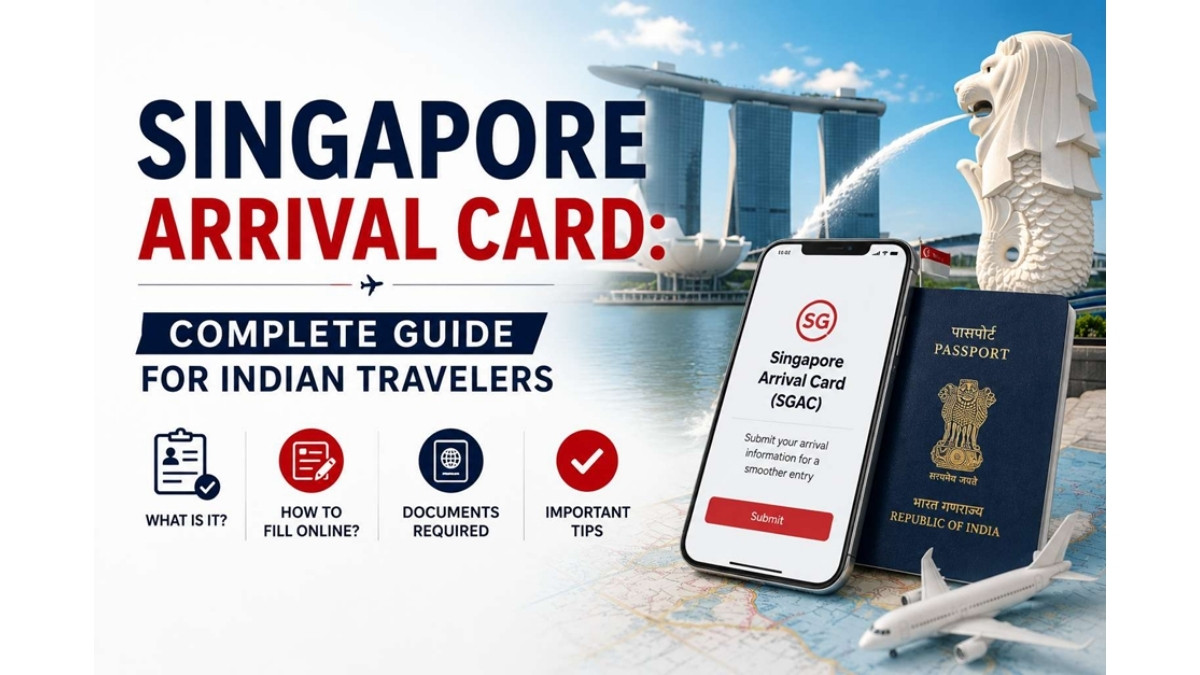
Singapore Arrival Card: Complete Guide for Indian Travelers
New Delhi [India], June 25: Singapore processes over 16 million international arrivals annually, with Indian nationals consistently ranking among the top three source countries by visitor volume....

New Delhi [India], June 25: Singapore processes over 16 million international arrivals annually, with Indian nationals consistently ranking among the top three source countries by visitor volume. Despite the straightforward nature of entry for well-prepared travellers, one documentation step continues to catch Indian visitors off guard: the arrival card. Changes introduced in 2024 shifted the process entirely online, meaning travellers who rely on airport paper forms or outdated advice are no longer compliant before they board.
The Singapore Arrival Card is now a mandatory pre-departure step, not an airport formality. Non-submission or incorrect completion creates delays at Singapore immigration that affect onward connections and leave a record of non-compliance on the traveller’s entry history. This guide covers the submission process, the errors Indian travellers make most often, and the entry requirements that sit alongside it.
What the Singapore Arrival Card Is and Who Must Submit It
The Singapore Arrival Card (SGAC) is a mandatory pre-arrival declaration submitted to the Immigration and Checkpoints Authority (ICA) of Singapore. It captures passport details, flight information, accommodation particulars, and a health declaration from every arriving traveller. The requirement applies to all nationalities, including Indian passport holders, regardless of whether they are visiting for tourism, business, or transit.
There are no exemptions based on nationality, visit frequency, or age for individual Indian travellers. Each person entering Singapore, including children of any age travelling with parents, must have a separately submitted arrival card linked to their own passport number. The only exemption categories are crew members on active duty with valid crew passes and certain government-to-government programme participants under specific ICA arrangements.
What the SGAC Does Not Replace
The arrival card fulfils the pre-arrival declaration requirement only. It does not serve as entry permission, does not substitute for a Singapore Visit Pass, and does not replace any travel insurance or accommodation confirmation that immigration officers may request. Indian travellers sometimes submit the SGAC and assume entry is confirmed. It is not. The Visit Pass is a separate mandatory requirement that must be in place before boarding.
How to Submit the Singapore Arrival Card Before Departure
The Singapore arrival card must be submitted through the official ICA portal at eservices.ica.gov.sg or the MyICA mobile application, available on Android and iOS. Submission is free. Third-party websites that charge a service fee for SGAC completion are not authorised by ICA. Their use introduces an unnecessary intermediary into a five-minute self-service process and carries the risk of data entry errors made by a third party against your passport.
The submission window opens 72 hours before the expected arrival time in Singapore. Submissions made earlier than 72 hours are rejected by the ICA system. Indian travellers on overnight flights that cross midnight should calculate the 72-hour window against the Singapore arrival time, not the India departure time, to avoid submitting too early and having the card expire before arrival.
Steps to Complete the SGAC Online
- Visit eservices.ica.gov.sg and select “Submit Arrival Card”
- Enter all passport details exactly as they appear on the biographical page
- Enter the flight number and the correct arrival date in Singapore
- Complete the health and travel history declaration
- Submit and save the confirmation reference number
No printed copy is required at Singapore immigration. The ICA system links the submission to the passport number and immigration officers retrieve it electronically when the passport is scanned. However, saving the reference number as a screenshot is advisable in case a manual query arises at the checkpoint.
Errors Indian Travellers Make Most Often
The most common SGAC submission errors from Indian passport holders involve date format confusion, where the portal requires MM/DD/YYYY but many applicants default to the DD/MM/YYYY format used in India. Entering an incorrect expiry date in this way causes a passport validity mismatch at the immigration counter. The second most frequent error is listing the Indian departure city as the “last port of embarkation” on connecting itineraries through Dubai, Doha, or Kuala Lumpur, rather than the actual last transit point. A third recurring issue is submitting the card against the wrong arrival date on overnight flights, resulting in a date mismatch that triggers manual verification on arrival.
Any mismatch between the SGAC and the physical passport presented at Singapore immigration initiates a manual verification check. These checks resolve at the counter but add 15 to 40 minutes to clearance time and can cause missed connections on tight layovers.
Singapore Entry Requirements for Indian Nationals Alongside the Arrival Card
Visit Pass Requirements
Indian nationals require a Singapore Visit Pass to enter. As of 2026, Indian passport holders are not eligible for visa-free entry and must hold a valid Visit Pass before boarding. The standard tourist Visit Pass grants a stay of up to 30 days and is applied for through an authorised local contact in Singapore or a registered travel agent. Indian travellers who visit Singapore frequently may benefit from a Multiple Journey Visa (MJV), which is valid for two years and permits multiple entries without individual applications per trip.
The SGAC cannot be submitted as a substitute for a Visit Pass, and travellers who arrive with a completed SGAC but no valid Visit Pass are stopped at the immigration counter. Both documents must be in place before departure from India.
Health Declaration Requirements
The health declaration within the SGAC asks travellers to confirm the absence of specified symptoms and to disclose recent travel to countries on Singapore’s active health advisory list. As of 2026, no mandatory health documentation beyond the self-declaration is required for Indian tourists and business visitors entering Singapore. The declaration is a statutory requirement under Singapore law, and making a false declaration is an offence under the Infectious Diseases Act.
What to Do If You Miss the SGAC Before Departure
Indian travellers who board without submitting the arrival card are not automatically denied entry. The ICA permits late submission via inflight wifi on carriers that offer this service, or through self-service kiosks located in the Singapore arrival hall before reaching the immigration counter. Kiosk availability during peak arrival periods is not guaranteed, and travellers who cannot complete the submission independently are directed to manual immigration counters, which carry significantly longer processing times.
Pre-departure submission through the ICA portal remains the correct approach. Engaging a reliable visa consultant before travelling to Singapore ensures that the arrival card, Visit Pass, and all supporting entry documents are confirmed and accurate before departure, eliminating any risk of delays at the checkpoint.
Conclusion
The Singapore Arrival Card is a mandatory pre-departure requirement for every Indian traveller entering Singapore, with no exemptions based on nationality or visit history. The move to online-only submission through the ICA portal means that travellers relying on airport paper forms or third-party websites are approaching the process incorrectly. Submitting within the 72-hour window, entering all passport details exactly as they appear on the travel document, and confirming the correct Singapore arrival date are the three factors that determine a smooth immigration experience. The arrival card and the Visit Pass are joint pre-departure requirements for Indian nationals, and both must be in place before boarding.