
Iran War Fallout Hits Surat Textile Hub: Powerloom Units Cut Production, Workers Face LPG Crisis
Rising yarn prices and black marketing of LPG cylinders threaten production and livelihoods in Surat’s powerloom clusters.

Advertisement
Surat | Gujarat — The ongoing conflict involving Iran, Israel and the United States has begun to severely impact Surat’s massive textile industry, pushing thousands of powerloom units and migrant workers into an unexpected crisis. With yarn prices—the main raw material for weaving—rising sharply by 25% to 45% within days, powerloom manufacturers have started reducing production while workers are struggling with an acute shortage of LPG cylinders for cooking.
Industry leaders say the crisis could disrupt the entire textile supply chain if immediate government intervention does not come.
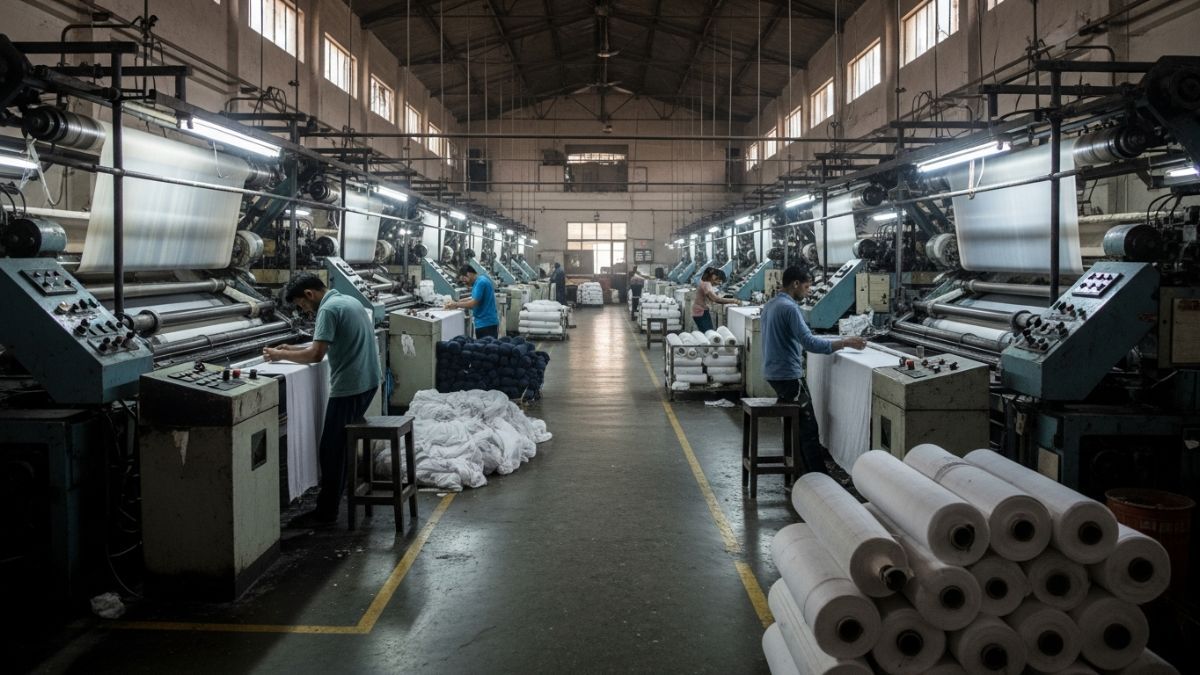
In the Pandesara, Bhestan and Sachin industrial belts, many powerloom manufacturers have voluntarily decided to shut their factories for two days a week in order to control production costs and losses.
“Within just ten days, yarn prices have shot up drastically due to the war-driven petroleum shortage. If we continue production at the current cost, many manufacturers will face severe financial losses,” said Mayur Golwala, a prominent leader of Surat’s powerloom industry.
Golwala warned that the situation is not limited to rising raw material costs. “The biggest concern now is the hardship faced by workers. If migrant workers cannot afford cooking gas or basic necessities, they will start returning to their hometowns. That will create a serious labour shortage and damage the industry further,” he said.
The crisis has been particularly severe in Sachin GIDC, where nearly three lakh textile workers live in housing clusters such as Rameshwar, Shivnagar, Siddhi Vinayak and Laxmivilla societies, along with nearby villages including Sachin, Kanakpur, Kansad, Paligam, Talangpur, Uber and Gabheni.
Most workers depend on 2.5 kg LPG cylinders for cooking. However, after the war disrupted petroleum supply chains, refill prices in the local black market have skyrocketed.
“Before the war, small cylinders were refilled at around ₹70 to ₹90 per kg. Now shopkeepers are charging between ₹500 and ₹700 per kg, openly exploiting poor workers,” Golwala said.
He alleged that black marketeers are taking advantage of the crisis and called for strict government action. “This is nothing but open robbery. We strongly urge the Food and Civil Supplies Department to conduct raids on those involved in black marketing. The police should also inspect general stores and take strict action against offenders,” he added.
Meanwhile, the ripple effect of the crisis is spreading across the textile ecosystem. Hot dyeing units operating in industrial areas like Bhestan, Un and Pandesara have also begun shutting down due to the shortage and high cost of industrial gas cylinders. Cylinders normally priced between ₹1,400 and ₹1,700 are reportedly being sold for ₹3,600 to ₹4,500 in the black market.
Industry leaders warn that if the war continues and supply disruptions worsen, Surat’s textile sector—often called the largest man-made fibre (MMF) hub in the country—could face one of its most difficult periods in recent years.
“If timely action is not taken to control raw material prices and stop black marketing, both workers and manufacturers will suffer. The impact could be felt across the entire textile value chain,” Golwala said.
Advertisement
