

India-first business software helps MSMEs digitise faster
Why MSMEs are shifting to homegrown business platforms designed for Indian workflows
As Atmanirbhar Bharat shifts from concept to everyday practice, a key question is emerging for business owners

Advertisement
New Delhi [India], November 6: As Atmanirbhar Bharat shifts from concept to everyday practice, a key question is emerging for business owners: Is this software truly built for India, or will we have to adapt our business to it? The distinction is crucial. When tools align with local workflows, onboarding is faster, teams embrace them sooner, and owners experience quicker improvements in cash flow and day-to-day operations.
More and more leaders are turning to India-first platforms that deliver three tangible benefits: rapid adoption, lower operational costs, and better oversight of sales, field teams, and inventory. The value proposition is clear — less customization, fewer workarounds, and faster results.
“Many founders spend too much time struggling with products that don’t match how we operate,” said the Founder & CEO of a homegrown tech company. “We designed our platform to reflect Indian realities — from GST compliance and regional language communication to WhatsApp-first field teams. The goal is straightforward: minimal setup, maximum impact.”
Why owners are switching to India-first software
This choice is pragmatic, not only patriotic. Owners in manufacturing, distribution and retail are switching because local platforms address real operational pain:
- Faster onboarding for teams that work in regional languages and coordinate primarily on WhatsApp.
- Cleaner compliance flows that reduce reconciliation headaches and GST surprises.
- Pricing and support aligned to MSME cash cycles instead of costly dollar-priced enterprise contracts.
Put simply: owners want tools that make running the business easier today and let them scale tomorrow — without long implementation roadmaps or expensive customization.
Outcomes that matter — not just features
Owners don’t buy feature lists; they buy results. The conversation has shifted to measurable improvements: fewer follow-ups, clearer sales visibility, predictable inventory and faster decisions. Practical advantages business leaders report include:
- Real-time WhatsApp alerts and automated reminders that cut manual follow-ups.
- AI-driven task prioritisation so managers focus on high-impact work first.
- Local integrations and hands-on support that shorten time to value.
A Mumbai MSME owner who piloted an India-built platform said: “We needed software that understands how we actually work. Rollout was simple, the team adopted it in weeks, not months — we immediately saved time.”
Tracker Suite
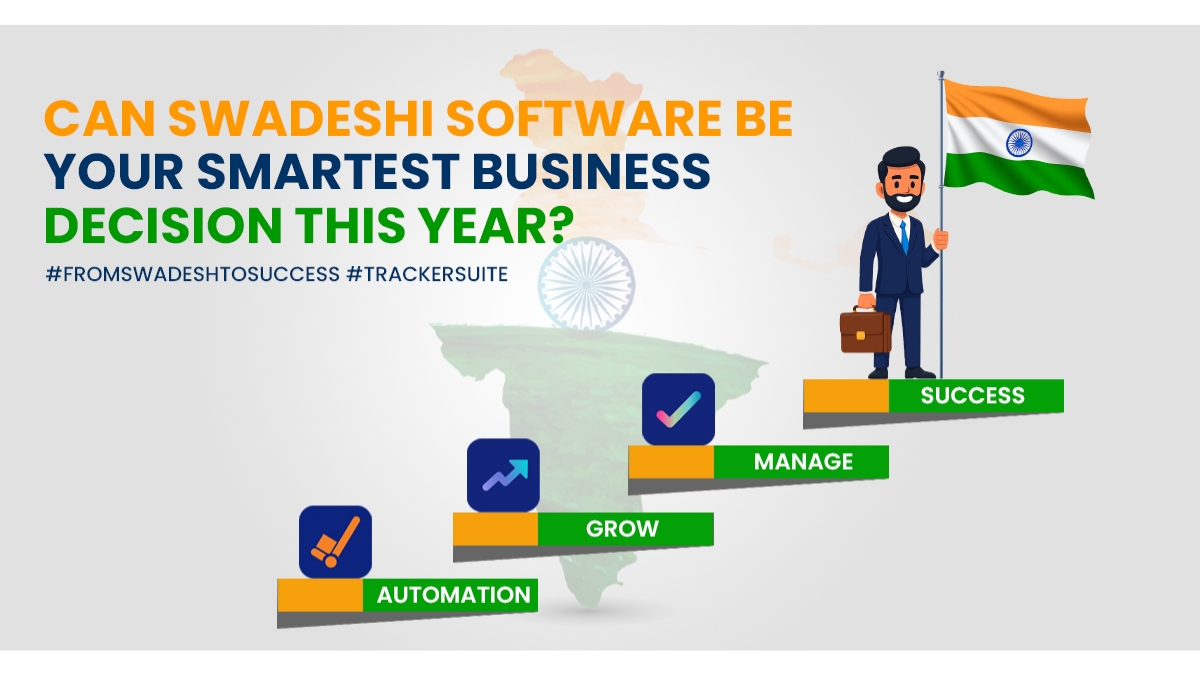
Among the homegrown solutions gaining traction is Tracker Suite, a Made-in-India platform built around Indian workflows. Instead of pushing generic templates, Tracker Suite focuses on practical onboarding and local integrations — small design choices that bring big operational gains. It also champions last-mile digitisation, connecting field teams, construction managers and on floor skilled labourers to the central system so on-ground work appears instantly in dashboards. That reduces reconciliation time and makes day-to-day management far more reliable.
Tracker Suite’s approach reflects a broader movement: platforms that listen to owners, iterate quickly, and support adoption with content and local help rather than long sales cycles.
How owners can evaluate and implement India-first software
Choosing software is a business decision. Here’s a simple, low-risk path owners can follow to evaluate and implement India-first tools effectively:
- Identify three daily pain points
Start with the problems that steal the most owner time — e.g., chasing field updates, late invoices, or frequent stockouts. If a product can solve two of these well, it’s worth piloting. - Ask for quick, focused demos
Request a 20–30 minute demo that shows exactly how the product solves your top pain points. Avoid long vendor presentations filled with features you don’t need. - Run a short pilot (14–30 days)
A low-friction pilot with one team or region reveals real fit. Set clear KPIs up front (see below) and measure results at the end of the pilot. - Measure the right KPIs
Track simple, meaningful metrics: onboarding time, reduction in manual follow-ups, days sales outstanding (DSO), percentage of stockouts, and support response time. These show business impact fast. - Check last-mile readiness
Make sure field teams can use the tool on basic phones and via WhatsApp or lightweight mobile apps. Last-mile digitisation is the difference between data you can trust and data you chase. - Evaluate support and pricing
Test support response during local business hours and ask for pricing aligned to your cash cycle — monthly or low-cost pilots reduce risk. - Scale incrementally
If the pilot hits KPIs, expand by region or use-case. Keep the rollout time-boxed and repeat the pilot approach for each new team.
Final thought — start small, measure what matters
For business owners, technology should solve problems — not create new ones. The most sensible approach is to start with a focused pilot, measure real outcomes in weeks, and scale what proves effective. Homegrown platforms that combine last-mile features with practical onboarding and local support make that path shorter and safer: they show evidence, in plain language, and let owners decide based on results — not on promises.
Business owners interested in a quick demo or a low-risk pilot can usually request one through the vendor’s website. Small pilots often reveal whether a solution truly reduces daily friction — and that’s the first sign of tangible digital return.
Advertisement
