








IIT Gandhinagar Scientists Develop Smart DNA Nanostructure for Precision Cancer Treatment
Gandhinagar | Gujarat — In a significant step toward safer and more effective cancer treatment, researchers at the Indian Institute of Technology Gandhinagar (IITGN) have developed an innovative...

Gandhinagar | Gujarat — In a significant step toward safer and more effective cancer treatment, researchers at the Indian Institute of Technology Gandhinagar (IITGN) have developed an innovative DNA-based nanostructure capable of targeting and destroying cancer cells with greater precision while minimizing damage to healthy tissues.
The breakthrough addresses one of the biggest challenges in conventional cancer therapies such as chemotherapy, which often attack both diseased and healthy cells, causing severe side effects. The IITGN team engineered microscopic DNA tetrahedrons—tiny pyramid-shaped structures made from DNA—and enhanced them using alpha-tocopherol succinate (αT), a molecule derived from Vitamin E.
The modified nanostructures demonstrated a remarkable ability to enter cancer cells more efficiently than conventional DNA carriers. Once inside, they triggered a chain reaction that generated harmful reactive oxygen species (ROS), leading to oxidative stress, cellular damage, and ultimately the programmed death of cancer cells.
The findings, published in the journal ACS Applied Bio Materials, highlight the growing potential of DNA nanotechnology in the fight against cancer. DNA nanostructures are increasingly being explored as next-generation drug delivery systems because of their stability, biocompatibility and ability to be precisely engineered for specific medical applications.
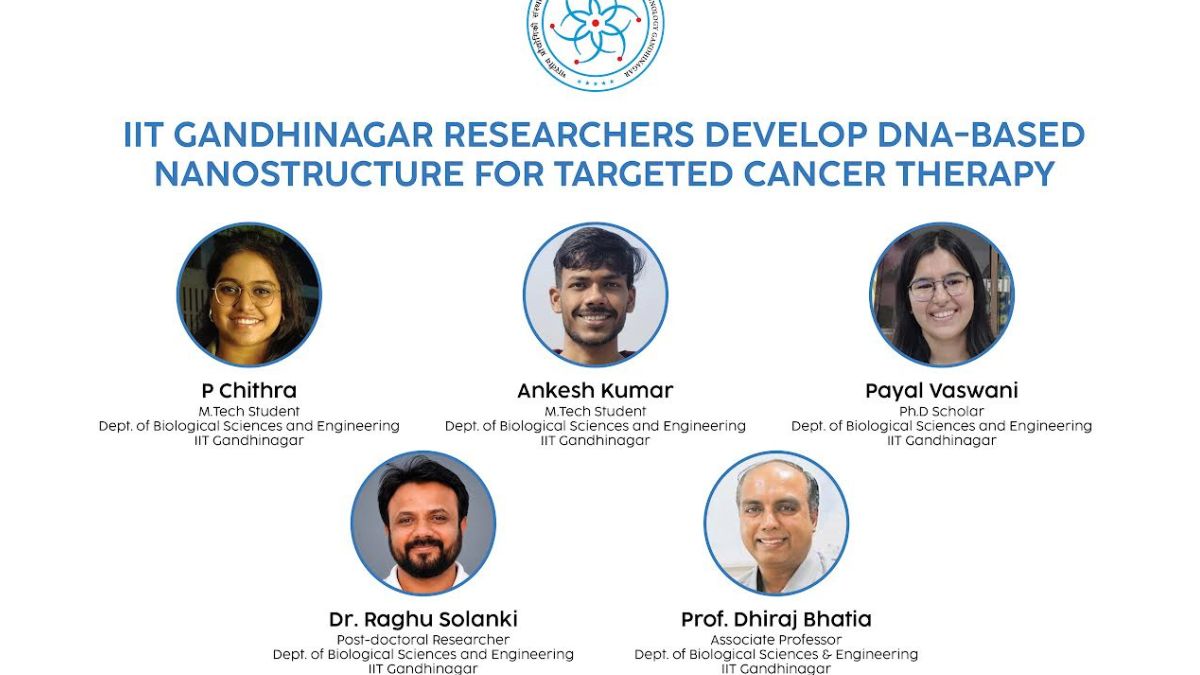
“What makes this work exciting is that we are starting to understand how small molecular modifications can dramatically influence biological behaviour,” said Dhiraj Bhatia, Associate Professor in IITGN’s Department of Biological Sciences and Engineering. He noted that carefully designed nanoscale structures could pave the way for more sophisticated and targeted therapies in the future.
Laboratory experiments revealed that the Vitamin E-derived modification improved interactions between the DNA nanostructures and cancer cell membranes, resulting in significantly higher uptake by cancer cells compared to healthy cells. Advanced imaging techniques confirmed the preferential accumulation of the nanostructures within tumour cells.
Lead researcher P Chithra said the consistency of the results across multiple experiments was particularly encouraging and demonstrated the practical potential of the design. Co-author Raghu Solanki added that the study underscores how fundamental insights into cell-nanomaterial interactions can lead to safer and more effective cancer treatments.
While the research remains at the laboratory stage, scientists believe the findings provide an important foundation for future animal studies and clinical trials. If successfully translated into medical practice, the technology could help usher in a new generation of targeted cancer therapies that are both more effective and less harmful to patients.