
Gujarat Marks “Constitution Assassination Day”
Today, as the nation observes the 50th anniversary of the imposition of the Emergency, Gujarat Chief Minister Bhupendra Patel unequivocally declared it a "tainted event in the democratic history of the country," branding it the "Constitution Assassination Day."

Advertisement
Gandhinagar, Gujarat — Fifty years ago, on the stroke of midnight, India’s democracy was plunged into its darkest hour. Today, as the nation observes the 50th anniversary of the imposition of the Emergency, Gujarat Chief Minister Bhupendra Patel unequivocally declared it a “tainted event in the democratic history of the country,” branding it the “Constitution Assassination Day.” This powerful commemoration aims to etch the harsh lessons of that period into the collective consciousness, ensuring future generations remain vigilant guardians of India’s foundational democratic values.
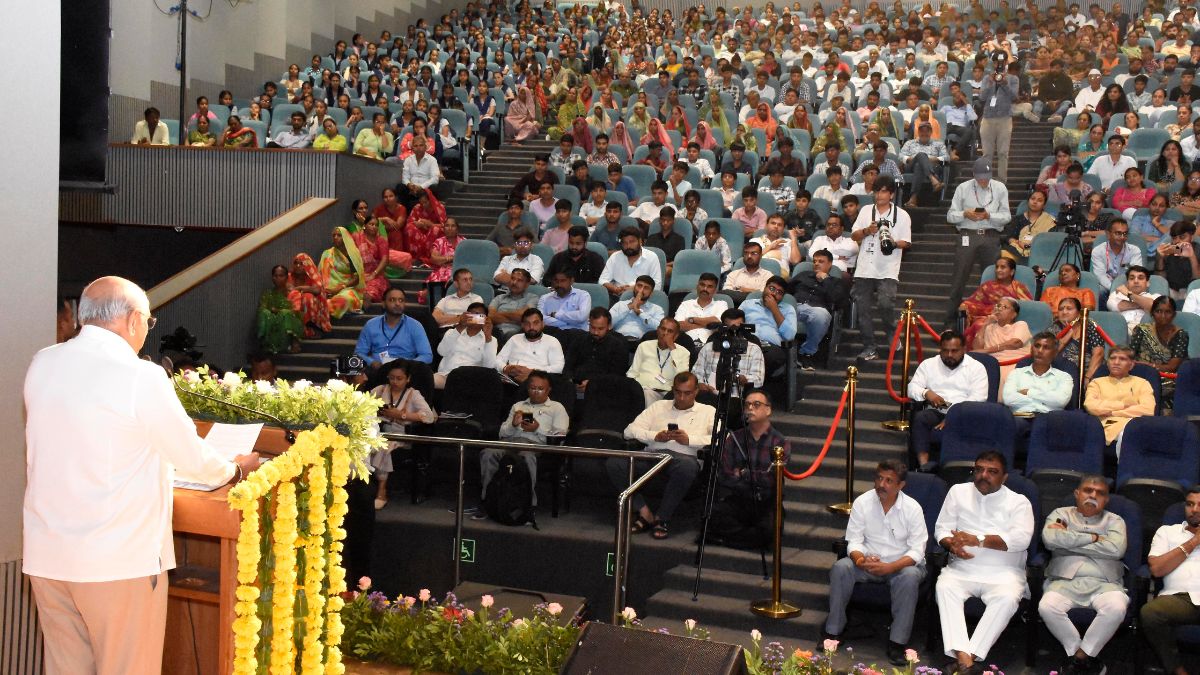
“The Emergency was a grave atrocity committed by the then government and Prime Minister on the very values of our Constitution,” stated Chief Minister Patel, his voice resolute, at a program organized to mark the solemn occasion. “Constitution Assassination Day is celebrated so that the present and future generations of our country realize this taint and become aware of the pride and dignity of the Constitution.”
The Chief Minister vividly recalled the challenging period, highlighting the unwavering commitment of Shri Narendrabhai Modi during those oppressive years. “Shri Narendrabhai Modi, in disguise, continuously fought against the government of that time to protect the Constitution and keep democratic values alive,” Patel revealed, underlining the Prime Minister’s personal struggle against the suppression of liberties. He further asserted that by imposing the Emergency, the then government had “crushed the soul of the Constitution,” which serves as the guiding beacon for governance and policy formulation.
In stark contrast to that dark chapter, Chief Minister Patel lauded Prime Minister Modi’s profound respect for the Constitution, evident in his governance. “Prime Minister Shri Narendrabhai Modi has shown the country and the world his high respect for the Constitution by considering the same Constitution and the national interest as supreme,” he added. He recalled a symbolic gesture from the Constitution’s 60th anniversary, when PM Modi, as the then Chief Minister of Gujarat, “had honored the Constitution by placing it on the tusks of an elephant,” a powerful visual repudiation of the Emergency’s assault on constitutional values.
Chief Minister Patel reaffirmed his government’s commitment to the Preamble’s spirit of “We the People,” pledging to realize the vision of a Developed India under the Prime Minister’s leadership through “support of all, development of all, trust of all and efforts of all.” He also highlighted key constitutional amendments made under Prime Minister Modi’s leadership, such as the Nari Shakti Vandana Act, the abolition of Triple Talaq, and the Citizenship Amendment Act. He underscored how “a united India has been created by removing 35-A and Article 370 from the Constitution in the interest of the citizens,” emphasizing the ongoing efforts to protect the Constitution in the nation’s best interest.
Law and Judiciary Minister Rushikesh Patel echoed the Chief Minister’s sentiments, emphasizing the critical role of citizens as “guardians of democracy.” He stressed the imperative for citizens to be “aware of their fundamental rights so that India, which runs on a democratic system, never goes towards dictatorship.” Minister Patel reminded the audience that during the Emergency, the fundamental rights of citizens were “usurped by the then government.”
“Today’s youth generation must learn a lesson from this incident,” Minister Patel urged, explaining the noble intention behind celebrating “Constitution Assassination Day-2025” nationwide under Prime Minister Modi’s guidance – to foster public awareness and ensure such a mistake is “never repeated in the future.” He elaborated that the then government, to maintain its dominance, misused Article 352 of the Constitution, imposing Emergency on the midnight of June 25, 1975, thereby “assassinating democracy and the Constitution” by stripping citizens of their fundamental rights.
The program also featured legal expert and retired Gujarat High Court judge, Ravikumar Tripathi, who provided a detailed exposition on the Indian Constitution, citizens’ fundamental rights, past amendments, and the historical misuse of constitutional articles, specifically focusing on the 1975 Emergency. His insights served to further educate and empower citizens regarding their constitutional entitlements and the vigilance required to safeguard them.
Advertisement
