

GJEPC Pushes Pre-Budget Reforms to Safeguard India’s Gem & Jewellery Exports Amid Global Headwinds
GJEPC seeks lower import duties, SEZ reforms and tax relief to counter global slowdown and rising competition

Advertisement
Surat | Gujarat — At a time when India’s gem and jewellery sector is grappling with global trade disruptions, rising competition, and slowing demand, the Gem & Jewellery Export Promotion Council (GJEPC) has submitted a comprehensive set of pre-Budget recommendations to Union Finance Minister Nirmala Sitharaman, seeking urgent policy support to protect exports, manufacturing, and employment.
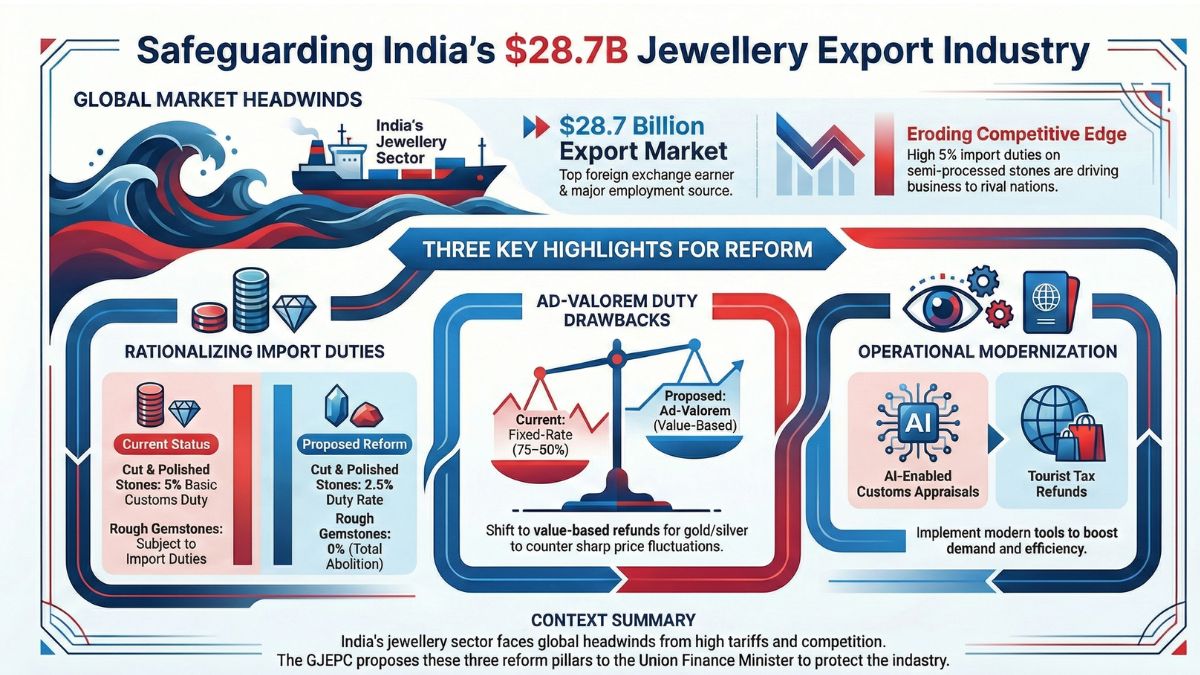
India’s gem and jewellery exports stood at USD 28.7 billion in FY 2024–25, making the sector one of the country’s largest foreign exchange earners and a major source of employment. However, the industry is under pressure due to beneficiation policies imposed by mining countries, high U.S. tariffs, geopolitical uncertainty, and the emergence of new rival cutting and trading centres in Africa and Southeast Asia.
One of GJEPC’s key demands is the rationalisation of import duties on cut and polished diamonds and coloured gemstones. Under existing rules, semi-processed diamonds imported from mining nations are classified as “cut and polished” and attract a 5% Basic Customs Duty (BCD). According to GJEPC, this classification significantly raises costs for Indian exporters and erodes their competitiveness in global markets.
A similar challenge exists in the coloured gemstone segment. Several rough gemstone–producing countries have restricted exports or imposed high duties, forcing Indian jewellers to import finished gemstones instead. The current 5% import duty on these stones adds to production costs, weakening India’s position against competitors such as Thailand and China. To address this, GJEPC has recommended reducing the duty on cut and polished diamonds and gemstones to 2.5% and abolishing import duties on rough gemstones altogether.
GJEPC Chairman Kirit Bhansali said the global trade environment is undergoing rapid transformation. “With high U.S. tariffs, shifting supply chains and changing consumer preferences, it is imperative that India maintains its competitive edge. Our pre-Budget proposals are focused on making exports more cost-efficient, strengthening SEZ operations, and positioning India as a global diamond trading hub,” he said.
Among other major recommendations is the introduction of an ad-valorem duty drawback system for gold and silver jewellery, replacing the existing fixed-rate mechanism that currently reimburses only 75–80% of duties paid. With gold prices fluctuating sharply between ₹99,000 and ₹1.25 lakh per 10 grams, GJEPC believes a value-based refund system is essential for exporter viability.
The Council has also called for extending duty drawback benefits to platinum jewellery and gold articles, especially for Domestic Tariff Area (DTA) exporters, to create parity with SEZ units. Notably, India’s platinum jewellery exports have grown nearly 17 times in the last five years.
To boost tourism-led demand, GJEPC has proposed a comprehensive tax refund scheme for foreign tourists, allowing refunds of all applicable taxes, not just GST, similar to global shopping hubs like Dubai and Singapore.
Further, GJEPC has sought greater flexibility for SEZ units, including reverse job work during export slowdowns and clearance of unsold inventory into the domestic market on duty payment. The Council has also urged amendments to the Customs Act, 1962, advocating risk-based clearances, AI-enabled appraisals, and uniform SOPs across ports.
Recognising India’s leadership in lab-grown diamonds, GJEPC has recommended extending the duty exemption on imported LGD seeds beyond March 2026, calling it critical for sustaining growth and employment in this fast-expanding segment.
Advertisement
