
At Youth Eco Summit 2026, youth, policymakers, and influencers confront AI’s environmental impact


Advertisement
Jaipur (Rajasthan) [India], February 17: As Artificial Intelligence increasingly shapes everyday life, questions around its environmental and social footprint are moving into the mainstream. At the Youth Eco Summit 2026, these concerns were explored through a convergence of cultural influencers, policymakers, and young voices highlighting the growing need for accountability in the age of rapid technological advancement. Organised by the Bajaj Foundation, brought together with the Ministry of Electronics and Information Technology, the Ministry of Environment, Forest and Climate Change, UNICEF YuWaah, and TECNO, the Youth Eco Summit brought together students from 66 cities across India, positioning youth at the centre of discussions on sustainability, accountability, and technological impact.
Actor Rohit Saraf, environmentalist and model Milind Soman, and UNDP India Youth Champion and actor Sanjana Sanghi all attended the summit and discussed the opportunities, problems, and responsibilities that come with the development of artificial intelligence. Their participation strengthened the notion that responsible innovation needs to be felt outside of boardrooms and institutions by adding a cultural perspective to discussions that have historically focused on technology and policy.
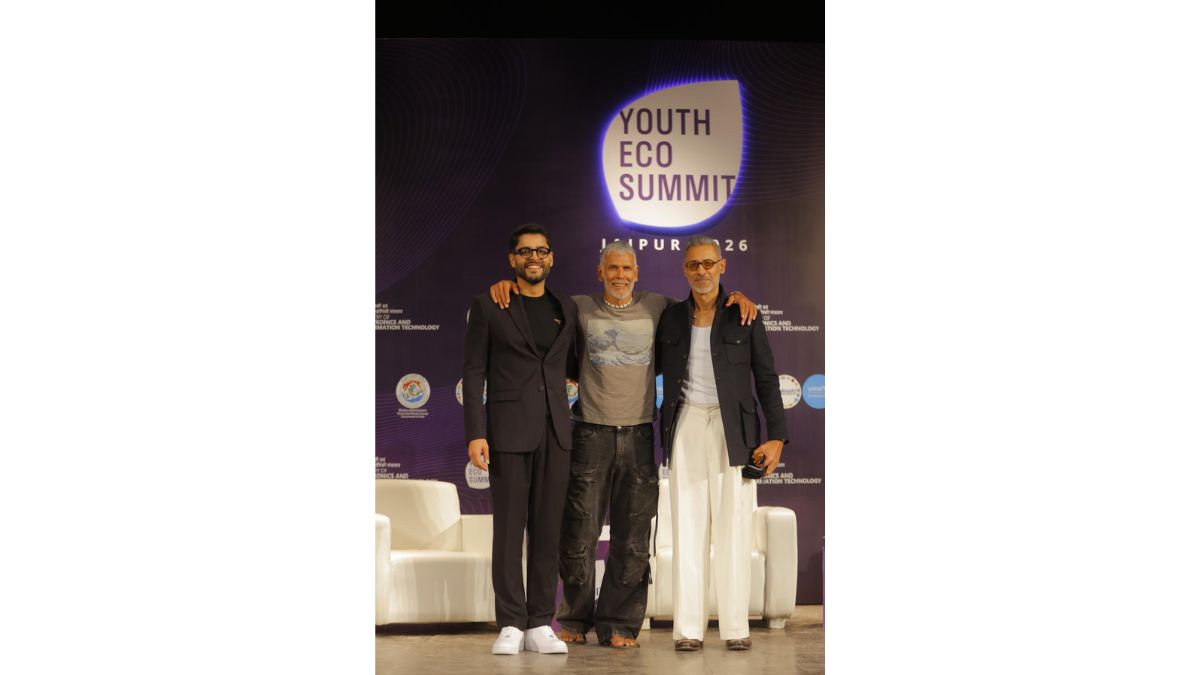
Adding a leadership perspective from the technology industry, Arijeet Talapatra, CEO of TECNO Mobile India, spoke about the responsibility that accompanies access to advanced technology. He noted that purpose-driven applications of AI have the potential to address environmental challenges, reduce waste, and encourage more sustainable lifestyles—emphasising that innovation must be guided by intent, not excess.
Policy and civic engagement perspectives were reinforced by Seep Agrawal, Lead – Civic Engagement at UNICEF YuWaah, who highlighted the importance of collaboration between youth, institutions, and cultural voices. She stressed that meaningful change occurs when young people are treated as collaborators in solution-building, rather than passive participants in dialogue.
The summit experience extended beyond panel discussions through the Green Education and Knowledge Lawn, which featured interactive zones such as Waste Reimagined, the TECNO Knowledge Walk, the TECNO AI Meme Studio, and the E-Waste Pledge Booth. These spaces translated complex sustainability challenges into tangible, experiential learning moments. At the TECNO AI Meme Studio, students explored themes of green coding, energy-conscious algorithms, and the often-overlooked resource demands of digital consumption. Using memes as a medium, participants transformed technical ideas into accessible narratives that resonated with their peers.
Offering a global perspective, Viransh Bhanshali, Chief of Staff at the Oxford Union, spoke about the convergence of technology, policy, and civic action, emphasising that emerging technologies must evolve alongside accountability frameworks to create lasting impact.
Concluding the summit, Pankaj Bajaj, Director of the Bajaj Foundation, underscored that the presence of students was driven by intent rather than obligation. He remarked that the real outcome of the Youth Eco Summit would be determined by whether the ideas discussed translate into action—choices that will ultimately shape the future.
Advertisement
