





Gujarat Policy 2026: Can Surat Become India’s Textile Tech Hub?
SURAT : Gujarat Industrial Policy 2026 should not be viewed simply as another investment and employment policy. It is an opportunity to fundamentally change the way Gujarat grows—and South Gujarat...

SURAT : Gujarat Industrial Policy 2026 should not be viewed simply as another investment and employment policy. It is an opportunity to fundamentally change the way Gujarat grows—and South Gujarat has a chance to lead that transformation.
For decades, Surat and the surrounding textile belt have built one of India’s strongest manufacturing ecosystems, powered by man-made fibres, yarns, weaving, processing, engineering industries and thousands of MSMEs. But the next phase of growth cannot depend only on producing more yarn and fabric. The real race will be to develop materials that perform better, solve complex problems and compete globally.
“The next phase of Gujarat’s growth should be driven by research, innovation, indigenous technology development, high-value manufacturing and global competitiveness,” I believe.
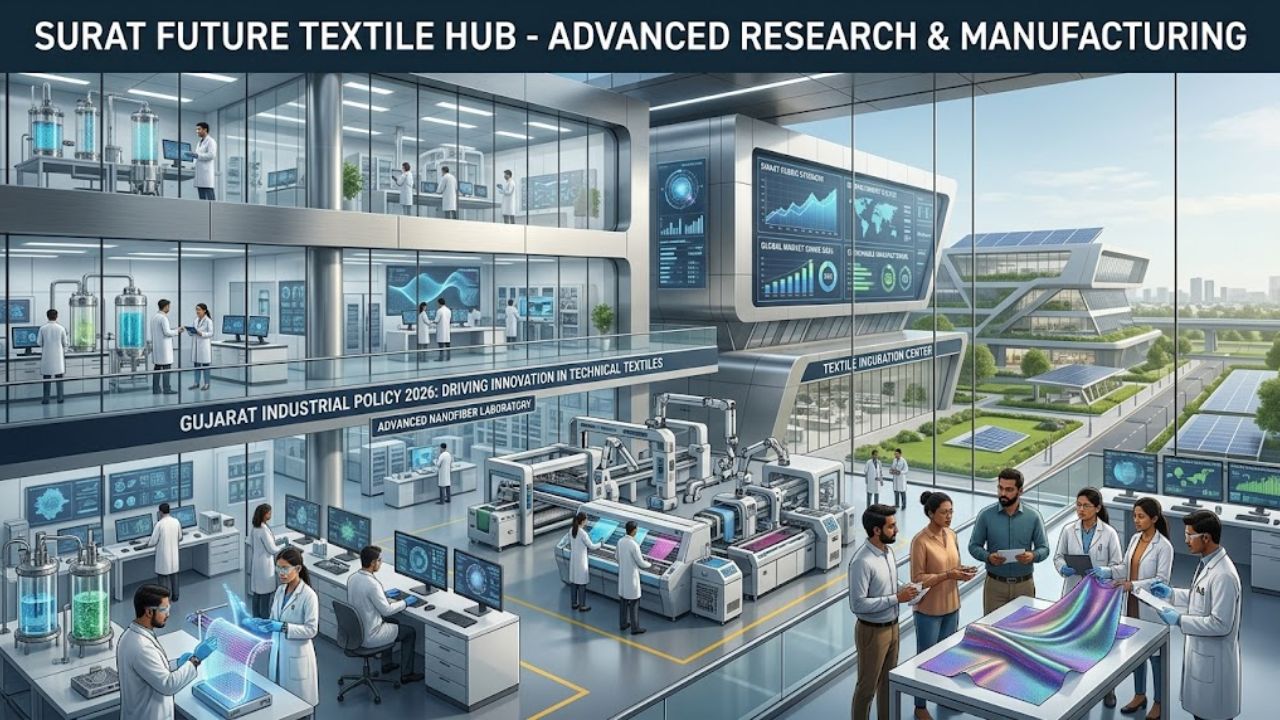
South Gujarat has the industrial foundation. What it needs now is a stronger bridge between industry and research. MANTRA, universities, scientific institutions, startups, testing laboratories, manufacturers and government agencies should work through a structured Research-to-Industry-to-Market model.
The future belongs to textiles that can provide thermal regulation, moisture management, antimicrobial protection, impact resistance, lightweight construction, durability, energy efficiency and intelligent performance. These are not merely textile products; they are advanced technologies.
This opportunity becomes even more significant as India looks towards major sporting milestones, including the 2030 Commonwealth Games and the proposed 2036 Olympic Games. India should aim not merely to manufacture sportswear for global events, but to develop the advanced materials behind sporting performance.
South Gujarat can become a national centre for advanced fibres, specialty yarns, compression textiles, moisture-management fabrics, smart textiles, protective materials, lightweight composites, artificial turf, geotextiles and sports infrastructure textiles.
“Our ambition should be that Indian fibres, Indian yarns, Indian fabrics and Indian Technical Textile technologies become part of India’s sporting and performance ecosystem,” I would emphasise.
For this to happen, R&D expenditure must be treated as an investment in industrial competitiveness, not simply an institutional cost. MSMEs often have technological challenges but lack the resources to establish independent R&D facilities. A shared ecosystem of laboratories, pilot plants, testing facilities and scientific expertise can bridge that gap.
South Gujarat can build a complete chain—from identifying an industrial problem to research, prototype development, testing, certification, technology transfer and commercial manufacturing. This can generate patents, startups, specialised MSMEs, licensing opportunities and export-oriented businesses.
MANTRA can serve as a bridge between scientific capability and real-world industrial requirements by converting industry problems into applied research programmes.
The vision should go beyond “Make in Gujarat” to “Research, Develop and Make in Gujarat.” If Gujarat Industrial Policy 2026 supports R&D, common testing infrastructure, pilot-scale facilities, industry-academia collaboration and technology transfer, South Gujarat can emerge as India’s leading hub for Advanced Technical Textiles and Sports Textile Research.
The opportunity is not merely to export textiles. It is to export Indian textile technology to the world.
(This article is authored by Dr Pankaj Gandhi, Director, MANTRA-Surat)