





Why Raste Could Become One of the Most Important Automotive Startups of the Decade
Every few decades, a company arrives that changes not just a product, but an entire industry’s way of thinking. Uber transformed transportation without building cars. Airbnb reshaped hospitality...

Every few decades, a company arrives that changes not just a product, but an entire industry’s way of thinking. Uber transformed transportation without building cars. Airbnb reshaped hospitality without owning hotels. Tesla forced the automotive world to rethink what a vehicle could be.
A young startup called Raste believes the next major transformation won’t be about how we drive; it will be about how vehicles understand themselves.
It is an ambitious vision.
Today, more than 1.5 billion vehicles travel the world’s roads, yet most still follow a maintenance philosophy developed decades ago. Drivers service their vehicles based on fixed mileage intervals, dashboard warning lights, or, too often, after something has already failed. Globally, billions of dollars are lost each year to preventable breakdowns, unexpected repairs, vehicle downtime, and inefficient maintenance.
Raste believes this entire model is outdated.
Instead of reacting to failures, the company has built an AI-powered platform that continuously interprets live vehicle data to recognize subtle mechanical changes long before traditional warning systems detect a problem.
If successful, the implications extend far beyond individual drivers.
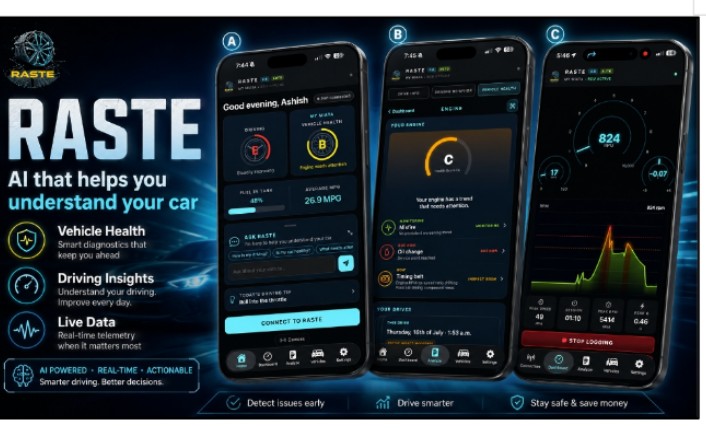
The company’s software continuously evaluates dozens of vehicle systems, including engine behavior, cooling performance, transmission health, braking characteristics, battery condition, fuel system efficiency, and driving patterns. Rather than overwhelming users with technical diagnostic codes, Raste converts complex engineering data into simple health scores, predictive insights, and personalized recommendations.
The experience resembles having an experienced automotive engineer riding inside the vehicle every day.
Every journey becomes another data point.
Each drive is automatically analyzed for fuel economy, safety, speed trends, acceleration behavior, braking patterns, and long-term mechanical changes. Drivers receive coaching that encourages safer habits while simultaneously helping reduce wear on expensive vehicle components.
Perhaps the platform’s most compelling capability is what it attempts to predict rather than simply detect.
Traditional onboard diagnostics are designed to identify faults after they cross predefined thresholds. Raste instead searches for gradual performance drift, small changes that may indicate components beginning to deteriorate weeks or even months before conventional warning lights appear.
That represents a significant shift in philosophy.
Instead of asking, “What has already broken?” the platform asks, “What is beginning to change?”
The answer could save consumers hundreds, or fleets, millions, of dollars in avoidable repair costs.
For commercial fleet operators, the value proposition may be even greater. Predictive maintenance can reduce unexpected downtime, improve vehicle utilization, optimize service scheduling, and extend asset life. In industries where every hour a vehicle sits idle translates directly into lost revenue, early intelligence becomes a competitive advantage.
Equally notable is the company’s conversational AI interface. Drivers no longer need to interpret cryptic diagnostic codes or spend hours searching online forums. They can simply ask questions such as “Why did my vehicle health score decrease?”, “Is my engine healthy?”, or “Should I schedule maintenance now?” and receive explanations in clear, understandable language.
The broader opportunity extends well beyond diagnostics.
As vehicles become increasingly connected and software-defined, the ability to continuously interpret automotive data may become as fundamental as navigation or telematics. In that future, Raste is not merely building another automotive application; it is attempting to create an intelligent operating layer between drivers and their vehicles.
Whether the company ultimately achieves that vision remains to be seen. Startups rarely lack ambition; what distinguishes exceptional ones is execution.
Yet history suggests that industries are often transformed not by those who manufacture products, but by those who fundamentally change how people interact with them.
The small team of Ph.D.s and industry experts at Raste lacks neither talent nor skills. The product is led by Ashish Ranjan as CTO. Before founding Raste, Ashish worked on the design and development of a next generation vehicle platform from scratch at a Silicon Valley EV startup, built and signed off on flight ready rocket engines, and worked on nuclear reactors in India’s nuclear program. The software is now functioning in pilot commercial fleets and is being used by early adopters who rely heavily on their vehicles for their work. If Raste succeeds, drivers may one day wonder how anyone ever maintained a vehicle without continuous, AI-driven insight. And the automotive industry may look back on predictive vehicle intelligence much the same way it now views GPS navigation or smartphone connectivity, not as a luxury, but as an expectation.
That possibility alone makes Raste one of the more intriguing mobility startups to watch in the years ahead