







Wooden Street Launches Industry-Leading 145-Night Trial for Penguin Sleep Mattresses to Guarantee Pain-Free Sleep
Wooden Street’s Penguin Sleep mattresses pair a 145‑night trial with Aerowave foam and tailored designs like Bamboo Bliss, Dream Lux and OrthoZen to address comfort, heat and back pain concerns.

Ask anyone who has bought a mattress in India in the last five years, and you will hear some version of the same complaint. It felt fine in the store. Three weeks in, the back pain returned, or the mattress started sinking in one spot, or it just got too warm to sleep on properly. The gap between how a mattress feels in a five-minute showroom test and how it performs after a month of actual use is where most buying regret comes from.
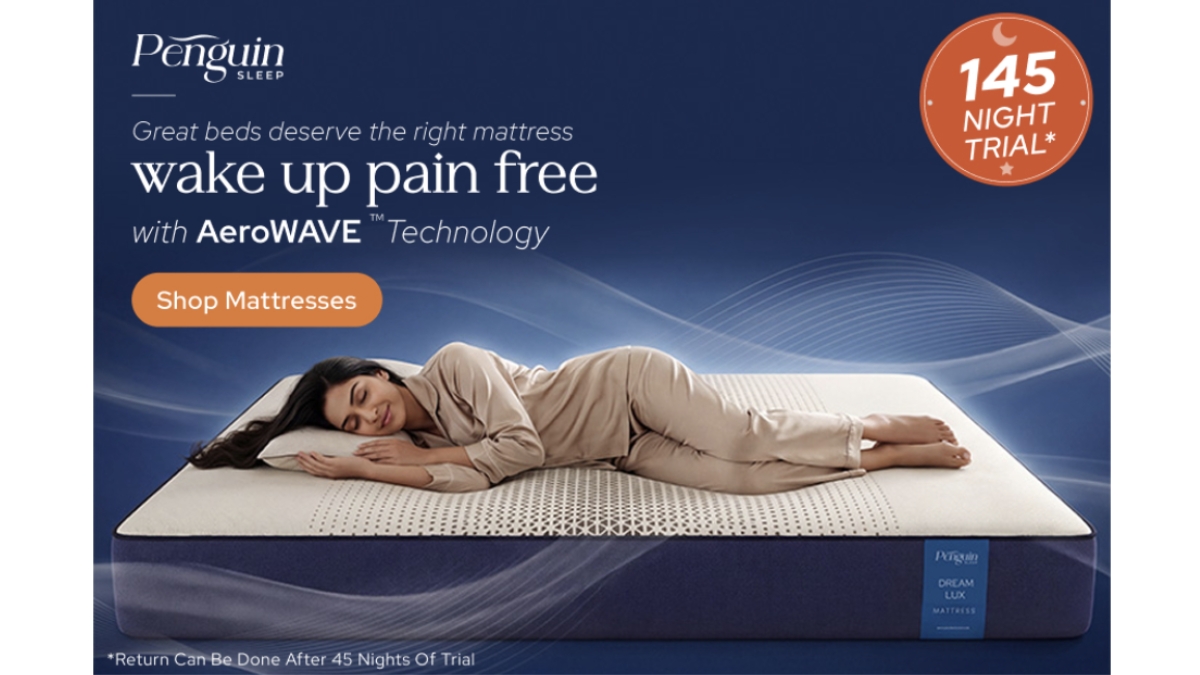
Wooden Street’s new Penguin Sleep range is built around closing that exact gap. The brand has rolled out a 145-night trial period on the collection, structured in two parts. The first 45 nights are a mandatory settling in period, during which returns are not processed. This is intentional. Foam mattresses, particularly ones with layered construction, need time to adjust to a sleeper’s body weight and posture, and a body needs time to adjust back. Once those 45 nights are over, customers move into a 100-night return window, giving them a genuine stretch of time to decide if the mattress is actually working for them, not just whether it felt comfortable on day one.
Why the Old Way of Testing a Mattress Falls Short
Physiotherapists have said this for years without much of the industry listening: spinal alignment and pressure-related discomfort don’t show up in a two-minute lie down. They show up after the tenth night of sleeping in one position, or after a week of the body trying to compensate for a mattress that’s slightly too soft or too firm in the wrong places.
A rushed showroom decision simply cannot account for that. Which is really the whole argument for a longer trial period in the first place, and why the settling-in window matters as much as the return window does. Comfort that shows up immediately isn’t always comfort that lasts.
What’s Actually Inside Penguin Sleep
The range is built around something called Aerowave, and it’s worth explaining because it’s not just a marketing term. Instead of a flat slab of foam, Aerowave uses a convoluted, egg-crate-style structure made of high-resilience foam. Picture thousands of small wave-shaped peaks across the surface. Each one moves independently, which means body weight gets spread across many contact points instead of piling up at the hips and shoulders, the two spots where most people feel pressure build overnight.
The valleys between those peaks aren’t just there for cushioning. They form open channels that let heat and moisture move away from the sleep surface instead of getting trapped, which is a real issue in a lot of Indian bedrooms, especially through the summer months. And because the foam is high resilience, it springs back almost immediately every time a sleeper shifts position, so the mattress keeps responding through the night rather than staying compressed in one shape.
The Range, Broken Down
Three mattresses currently make up the collection, each built for a slightly different sleeper.
Bamboo Bliss leans toward plush. It pairs a bamboo-infused fabric cover with a soft, cloud-like comfort layer, which tends to work well for side sleepers who want more give in the surface. Below that sits a breathable latex layer with pinhole ventilation, and underneath, a five-zone high-resilience foam layer handles the actual support work, adjusting firmness across different parts of the body rather than treating the whole mattress as one uniform slab.
Dream Lux is aimed more at couples. The mesh fabric cover keeps airflow moving, while an adaptive memory foam layer contours to each sleeper’s shape and limits motion transfer, so one partner rolling over doesn’t wake the other. The Aerowave layer sits underneath, doing its usual job of spreading pressure and managing heat.
Then there’s OrthoZen, which is where back pain specifically comes into the conversation. It uses a mesh knitted, removable cover, with the Aerowave layer placed closer to the sleep surface so it responds directly to spinal pressure and movement. For readers actively searching for the best mattress for back pain relief, OrthoZen’s layering was clearly built with that exact problem in mind rather than as a general purpose option.
Why Walking Into a Store Still Makes Sense
A longer trial period is useful, but it doesn’t replace the value of physically checking a mattress before it comes home. Firmness perception varies a lot from person to person, and a mattress that reads as medium firm to one sleeper can feel noticeably different to another depending on body weight and sleeping position. That’s not something a product description can fully solve.
There’s also the question of what the mattress sits on. A lot of customers upgrading their sleep setup end up rethinking the bed frame at the same time, particularly things like height, storage, and how the frame’s finish works with the room. For anyone in that stage, it’s worth looking at Double Bed Designs by Wooden Street, since frame height and base type genuinely affect how a mattress performs, not just how the room looks. A mattress and a mismatched frame can undercut even the best foam layering.
Store visits also let customers actually feel the difference between something like Bamboo Bliss and OrthoZen in person, which is hard to judge from specifications alone, however detailed they are.
Where This Leaves the Category
A 145-night trial, with its 45-night settling-in period built in deliberately rather than tacked on for show, says something about where mattress buying is headed. Customers are asking harder questions than they used to. They want to know how a mattress performs in month two, not just how it feels on the first night, and they’re less willing to take a brand’s word for it without some kind of proof built into the buying process itself.
Whether every mattress brand in India follows this model is hard to say. But the shift toward giving customers real time to test comfort, rather than rushing them into a decision, looks like the direction the category is moving in. For now, Penguin Sleep is one of the more concrete examples of what that shift actually looks like in practice.