







Environment Day Spotlight Falls on Surat Airport’s Unfulfilled Green Commitments
Surat | Gujarat — As World Environment Day celebrations unfolded across Gujarat and Prime Minister Narendra Modi highlighted sustainability and environmental responsibility during his visit to the...

Surat | Gujarat — As World Environment Day celebrations unfolded across Gujarat and Prime Minister Narendra Modi highlighted sustainability and environmental responsibility during his visit to the state, a critical question surfaced closer to home: Has Surat Airport delivered on the environmental promises that accompanied its ambitious expansion project?
While government agencies and civic bodies marked the occasion with large-scale plantation drives and green initiatives, environmental observers and local residents are drawing attention to commitments made by the Airports Authority of India (AAI) during the approval process for Surat Airport’s ₹353-crore holistic development project.
The airport expansion, which included terminal upgrades, apron expansion and the construction of a parallel taxi track, was granted environmental clearance based on a detailed Environmental Impact Assessment (EIA). Beyond infrastructure development, the report outlined an extensive environmental management plan aimed at mitigating the ecological impact of the project.
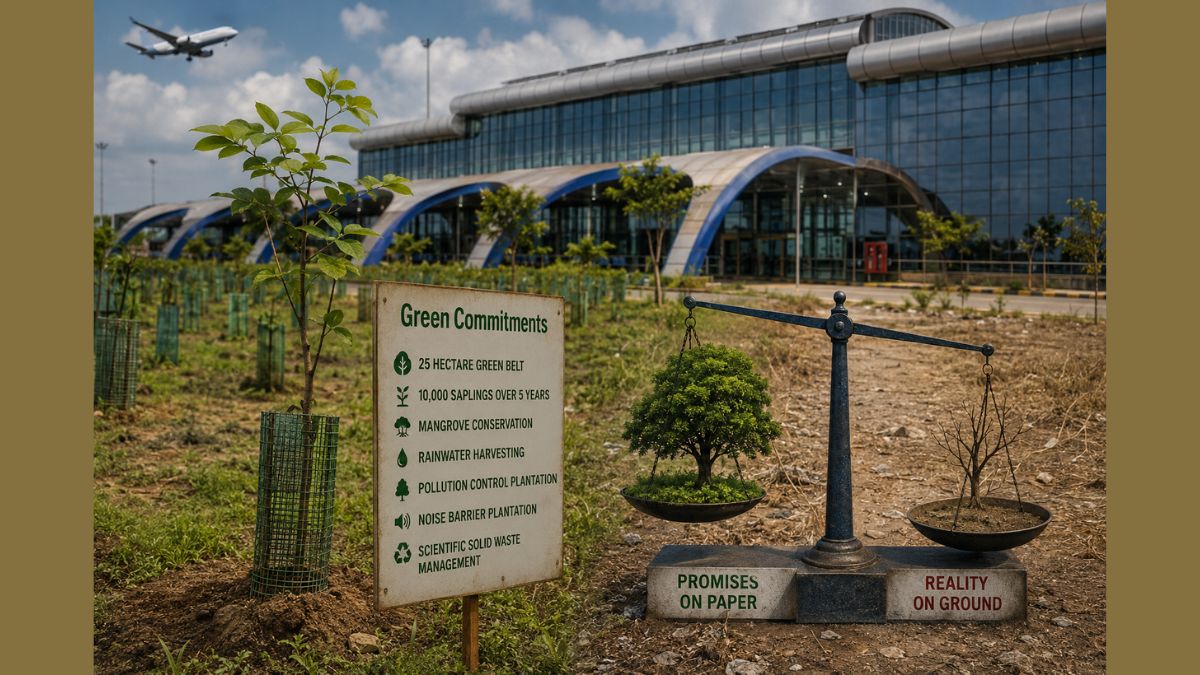
Among the commitments were the development of a 25-hectare green belt, plantation of approximately 10,000 saplings over five years, mangrove conservation measures, rainwater harvesting systems, pollution-control plantations and scientific solid waste management practices. The EIA also emphasised dense plantation along residential zones to reduce noise pollution and improve biodiversity around the airport.
However, several years after these commitments were made, questions remain about their implementation.
“Environmental safeguards are not optional add-ons to development projects. They form the very basis on which clearances are granted,” say environmental advocates monitoring urban infrastructure projects in the region.
Residents living near the airport claim that large stretches of the airport boundary do not reflect the scale of green belt development envisioned in official documents. Equally concerning is the absence of publicly accessible information regarding plantation targets, survival rates of saplings, expenditure incurred on environmental measures and periodic compliance reports.
The issue extends beyond Surat Airport alone. Experts argue that transparency in environmental compliance is becoming increasingly important as cities across India grapple with rising temperatures, shrinking green cover and worsening urban heat island effects.
“When public agencies seek environmental approvals, the commitments made must be treated with the same seriousness as construction timelines and budget allocations,” environmental experts point out.
No one disputes the importance of airport expansion and modern infrastructure. Surat’s growing economic significance requires world-class aviation facilities. The debate, however, centres on accountability. If hundreds of crores can be invested in concrete and steel, stakeholders ask why environmental commitments remain largely invisible to the public eye.
Prime Minister Modi has repeatedly advocated environmental stewardship through initiatives such as Mission LiFE and community-led sustainability efforts. Against this backdrop, Environment Day presents an opportunity for AAI and the Ministry of Civil Aviation to proactively disclose the status of green belt development, plantation achievements, environmental monitoring reports and spending under ecological commitments.
For a city aspiring to be a model of sustainable growth, the measure of progress cannot be limited to airport terminals and infrastructure alone. It must also be reflected in thriving green belts, transparent environmental governance and promises that move beyond paper into reality.