




Before Gen Z’s Cockroach Movement, Zehraben Fought Alone in Surat
Surat | Gujarat — Every cockroach has an origin story. India’s Gen Z just discovered the cockroach as a symbol of defiance, turning it into a party that calls itself the “Voice of the Lazy and...

Surat | Gujarat — Every cockroach has an origin story.
India’s Gen Z just discovered the cockroach as a symbol of defiance, turning it into a party that calls itself the “Voice of the Lazy and Unemployed.” Millions of followers, memes, manifestos — the whole circus. But before anyone put a cockroach on an Instagram logo, there were quiet, unsung cockroaches in this country who took on the powerful with nothing but nerve and, sometimes, a good biryani.
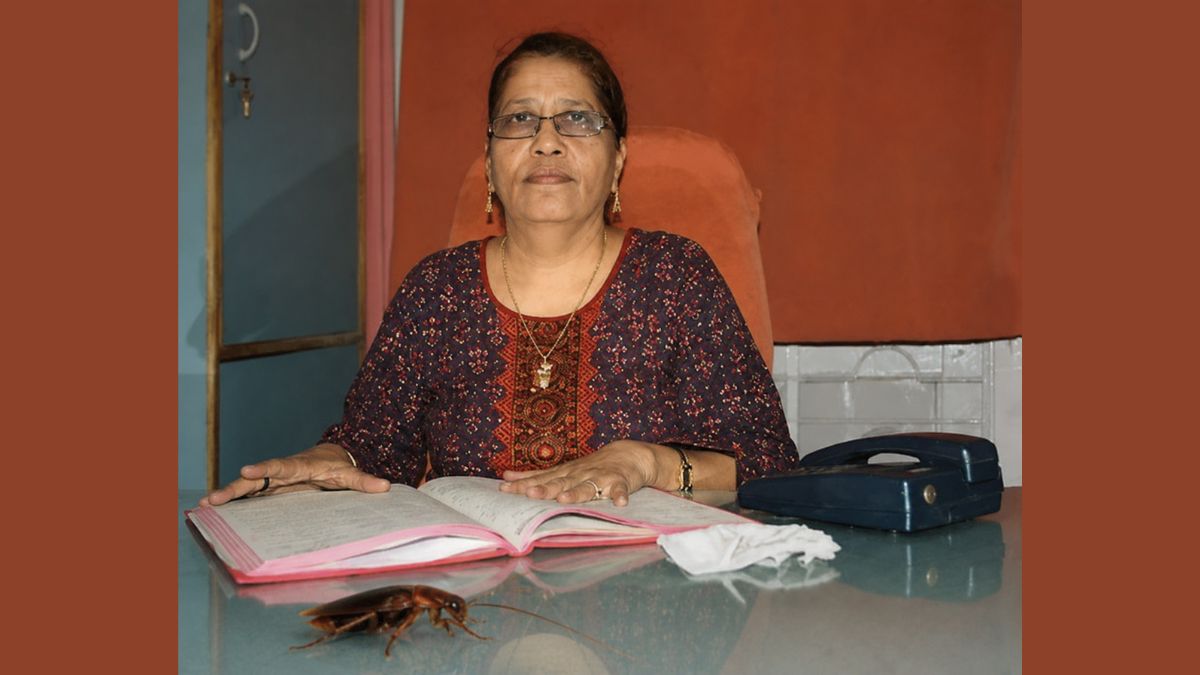
Zehraben Cyclewala was one of them.
In 1985, when the Dawoodi Bohra community’s supreme religious leader issued a decree asking his followers to quit jobs involving bank interest, Zehra refused. She was the first Bohra woman in Surat to defy the Syedna’s order — and possibly the first anywhere.
Zehra asked one simple question: who will feed me and my mother? She also pointed out that the housing complex in which the bank was located was inaugurated by Syedna himself and rent was being collected from it. So, how come?
For that act of defiance, a campaign was launched to excommunicate her from the community. What followed was years of isolation, hostility, and some days just one meal. Neighbours spat on them. Her tuition students disappeared. Her entire social world evaporated overnight.
She fought back — in courts, police stations, and the grinding machinery of Indian bureaucracy — and started winning. What began as a fight for her job became, case by case, a fight for human rights.
I went to meet her for a story, after reading a small newspaper item back when this was happening. Reached her Surat flat just after breakfast. It was so small, a 3 seater sofa occupied half the drawing room. She was inside the kitchen, making mutton biryani. Before I could even pull out my notepad, she asked if I was staying for lunch. I mean — who says no to mutton biryani? A glass of extra basmati went straight to the boil.
Born to a poor family from Saat Gaam, where girls rarely saw the inside of a classroom, Zehra became her village’s first female college graduate. Her father had come to Surat, opened a cycle repair shop, and built a modest life. After he died young, her mother became her rock. Life was straightforward until 1985. A BCom graduate with a job at Saif Co-operative Society, she wanted one thing: to make money.
Mid-conversation, she called someone and introduced me as “Abbas bhai, if I remember correctly.” That Abbas bhai (or whoever I spoke to) turned out to be from the family behind Sosyo — yes, the Hajoori family. Abbas Rahim Hajoori, a young man from Surat, had in 1923 invented India’s very own homegrown fizzy drink, named it Socio from the Latin word for “friend or ally” — a deliberate thumbs-down to foreign brands. Surat promptly mispronounced it “Sosyo,” and by 1953 the company just accepted it and renamed itself. Sometimes the people win simply by talking the way they talk.
She handed me the phone mid-conversation. I assumed it was someone calling to offer support. Instead, a man on the other end (Abbas bhai) launched straight into a tirade — furious that I was giving column space to someone who had dared defy the top establishment. I sat there, notebook open, listening patiently. By the end of the call, he had no idea he’d just quoted himself into my story.
That was Zehraben’s way. She didn’t argue back. She just let you walk into the frame.
She didn’t need a movement. She was the movement — running entirely on quiet nerve and the occasional strategic phone handover.
Years later she called me — I was with Anosh at a roadside café in Ahmedabad — saying she had written her memoir in Gujarati and now wanted it in English, for a wider audience. We couldn’t help because we were too busy and also not into the publishing industry.
Months later, a book landed at my door. I opened it, started the first paragraph, and immediately felt like I had accidentally picked up a court filing. Appellant. Defendant. Whereas. Hereinafter. Every sentence read like something you’d sign under duress.
I flipped to see who had translated it.
Of course. It was her advocate.
God bless him — he fought her battles beautifully in court. But when he sat down to translate her life, he did what all of us do: he wrote in the only language he truly knew. The result was a memoir that read like a summons.
It had been years. I called her last week through a journalist friend in Surat who had her number. She picked up. Did not remember me. Why would she — she has met hundreds of journalists over the decades, each of us arriving with our notepads and our earnest questions, then disappearing back to wherever we came from.
But the spirit was unchanged. Same Zehraben. Older, yes. Alone now, in a newer flat, somewhere better than the old one. The policeman at the door is presumably no longer needed, or perhaps she just stopped asking.
She invited me over. Mutton biryani again.
I said yes before she finished the sentence.
The Gen Z cockroaches today have memes and Instagram and millions of followers. Zehraben had a flat in Surat, a biryani on the stove, and a lawyer who loved legal phrases.
She was still the tougher cockroach.
(This story first appeared on https://boilandsteam.medium.com/the-original-cockroach-who-fought-the-powerful-alone-395caa698f6e)