


Sea Water Creeps Into Surat’s Groundwater, Uranium Levels Raise Alarm in Gujarat: CGWB Report
Surat | Gujarat — Surat is staring at a silent environmental emergency as salt water from the Arabian Sea is steadily seeping into underground freshwater reserves, contaminating groundwater across...

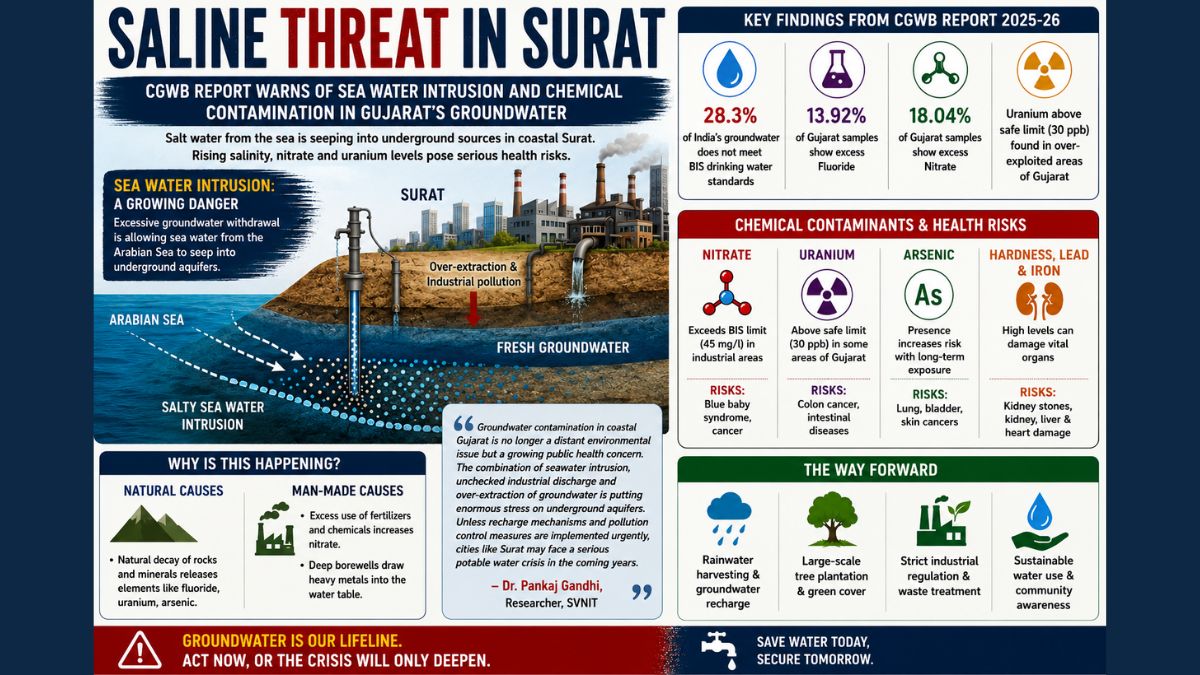
Surat | Gujarat — Surat is staring at a silent environmental emergency as salt water from the Arabian Sea is steadily seeping into underground freshwater reserves, contaminating groundwater across coastal belts and industrial zones. A new annual report by the Central Ground Water Board (CGWB) for 2025-26 has sounded a serious warning over rising salinity, nitrate pollution and dangerous chemical contamination in Gujarat’s groundwater, particularly in coastal districts like Surat.
The report paints a grim picture of Gujarat’s fragile coastal and semi-arid regions, where excessive groundwater extraction, rapid urbanisation and industrial discharge are pushing underground water sources toward irreversible damage. In Surat and South Gujarat, experts say the twin assault of seawater intrusion and industrial pollution is steadily degrading drinking water quality.
According to the report, seawater intrusion has intensified in coastal regions due to excessive withdrawal of groundwater. As freshwater tables decline, saline seawater enters underground aquifers, increasing electrical conductivity and salt concentration in drinking water sources.
The CGWB report further states that nitrate levels in several industrial areas have exceeded the Bureau of Indian Standards (BIS) permissible limit of 45 milligrams per litre. Alarmingly, uranium contamination above the safe limit of 30 parts per billion (ppb) has also been detected in over-exploited groundwater zones of Gujarat and several other Indian states.
Environmental experts warn that prolonged consumption of contaminated groundwater could trigger severe health complications ranging from cancer and kidney damage to intestinal disorders.
“Groundwater contamination in coastal Gujarat is no longer a distant environmental issue but a growing public health concern,” said Dr. Pankaj Gandhi. “The combination of seawater intrusion, unchecked industrial discharge and over-extraction of groundwater is putting enormous stress on underground aquifers. Unless recharge mechanisms and pollution control measures are implemented urgently, cities like Surat may face a serious potable water crisis in the coming years.”
Health experts cited in the report noted that excess nitrate in drinking water can lead to “blue baby syndrome” in infants and may increase cancer risks in adults. Uranium contamination has been linked to colon and intestinal diseases, while arsenic exposure raises the risk of lung, bladder and skin cancers. High hardness and carbonate content can contribute to kidney stones, while lead and iron contamination may damage the liver, kidneys and heart.
The report revealed that nearly 28.3 percent of India’s groundwater samples no longer meet BIS standards for drinking water. Gujarat recorded excess fluoride in 13.92 percent of tested samples and nitrate contamination in 18.04 percent of samples.
Although Surat district has not yet been classified among the state’s most severely affected regions, the report warns that unchecked industrial expansion and increasing dependence on borewells could rapidly worsen the situation.
Prof. S.K. Tank stressed the need for urgent corrective measures. “Rainwater harvesting, large-scale groundwater recharge and tree plantation drives are essential if we want to prevent long-term ecological and health damage,” he said.