







Why India Is Facing Extreme Weather Swings
Surat | Gujarat — The unusual and unstable weather changes currently being observed in India—such as intense heat as early as March, followed by sudden rainfall, dust storms, hailstorms, and sharp...

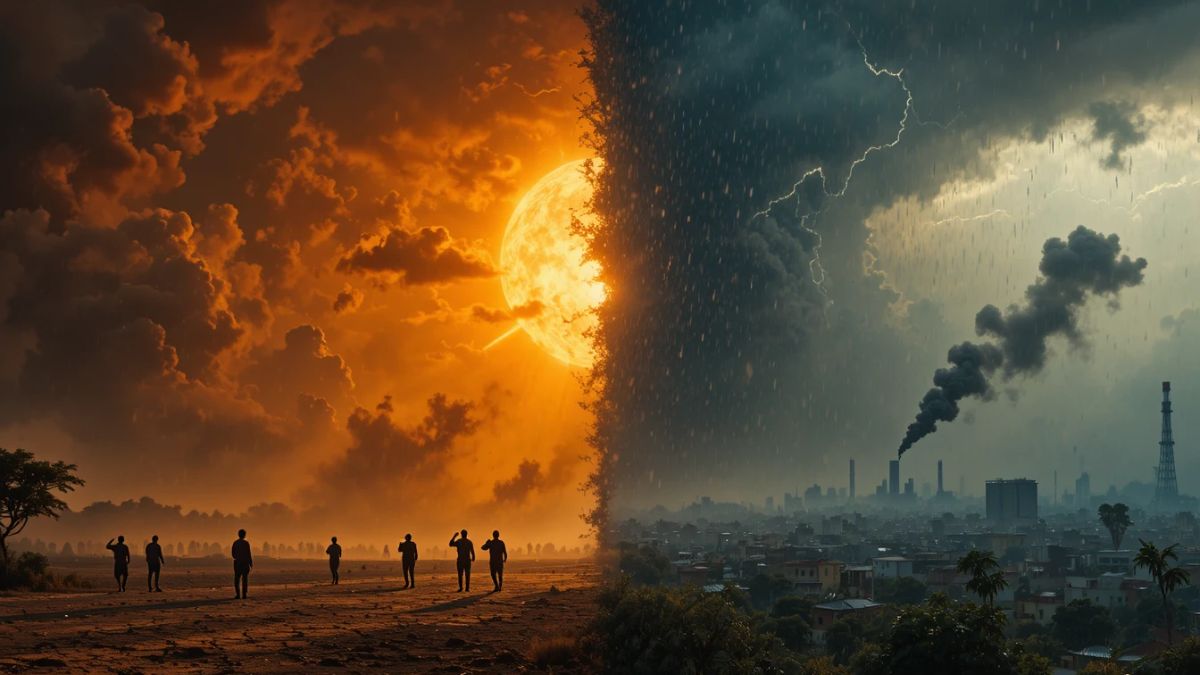
Surat | Gujarat — The unusual and unstable weather changes currently being observed in India—such as intense heat as early as March, followed by sudden rainfall, dust storms, hailstorms, and sharp drops in temperature—are not caused by a single factor but are the result of a combination of both natural and human-induced influences.
From a short-term perspective, factors such as Western Disturbances (cold air systems originating from the Mediterranean region), shifts in jet stream patterns, and reduced winter rainfall lead to lower soil moisture, causing the land to heat up more rapidly and triggering an early onset of intense heat.
When this hot air rises and interacts with moisture-laden air, it creates sudden cloud formation, rainfall, thunderstorms, and hail events—resulting in the unusual experience of extreme heat and stormy conditions within a short time span in the same region.
However, these are only immediate meteorological processes; the deeper causes lie in long-term global and environmental changes. The continuous rise in global temperatures (global warming), driven primarily by increasing levels of greenhouse gases such as carbon dioxide (CO₂) and methane (CH₄), traps more heat within the Earth’s atmosphere, intensifying both the duration and severity of heatwaves.
This not only raises average temperatures but also makes weather systems more volatile, leading to irregular rainfall patterns and an increase in extreme weather events. Additionally, deforestation reduces natural temperature regulation, while rapid urbanization (Urban Heat Island Effect) causes cities to absorb and retain more heat due to concrete and asphalt surfaces, preventing temperatures from cooling even at night.
The depletion of water resources and declining soil moisture further disrupt atmospheric balance. Together, these factors are gradually destabilizing India’s traditional seasonal cycle—winter, summer, and monsoon—blurring the boundaries between seasons and making weather increasingly unpredictable and extreme.
As a result, critical sectors such as agriculture, water management, public health, and energy are being significantly impacted, clearly indicating that these changes are not just seasonal anomalies but manifestations of long-term climate change.
To reduce the risks arising from increasingly unstable and extreme weather conditions in India (such as heatwaves, irregular rainfall, and storms), a coordinated approach is required across multiple dimensions—policy, technology, environment, and public awareness. Below is a structured and strategic framework:
- Government-Level Actions (Policy & Governance Reforms)
- Climate-focused Policies
- Strengthen Climate Action Plans at national and state levels
- Enforce stricter regulations to reduce carbon emissions
- Make ESG (Environmental, Social, Governance) compliance mandatory
- Emphasis on Renewable Energy
- Increase investment in solar, wind, and green hydrogen
- Gradually reduce dependence on coal-based energy
- Urban Planning Reforms
- Implement “Heat Action Plans” in all major cities
- Expand green zones, urban forests, and open spaces
- Introduce heat-resistant building codes
- Ecological Measures (Environmental Protection)
- Large-scale Afforestation
- Promote tree plantation in both rural and urban areas
- Restore riverbanks and degraded land
- Water Management
- Make rainwater harvesting mandatory
- Develop check dams, lakes, and groundwater recharge systems
- Promote micro-irrigation (drip/sprinkler systems)
- Soil and Land Conservation
- Encourage organic farming and soil moisture retention techniques
- Take measures to prevent desertification
- Technology & Data-driven Solutions
- Improved Weather Forecasting
- Use AI-based predictive systems
- Provide real-time alerts at the district level
- Climate-smart Agriculture
- Promote climate-resilient crop varieties
- Encourage smart irrigation and data-driven farming
- Disaster Management Systems
- Develop early warning systems for heatwaves, floods, and storms
- Establish rapid response mechanisms
- Public Awareness & Behavioural Change
- Awareness Campaigns
- Promote campaigns like water conservation, tree plantation, and energy saving
- Introduce climate education in schools and colleges
- Lifestyle Changes
- Reduce use of private vehicles; promote public transport
- Use energy-efficient appliances
- Minimize plastic use and reduce waste
- Industry & Economic Measures
- Green Industry Transition
- Encourage industries to adopt low-carbon technologies
- Promote carbon credits and green financing
- Sustainable Supply Chains
- Adopt environmentally responsible practices in raw materials and production
- Strengthen waste-to-energy and recycling systems
6.Health & Human Safety
- Heat Action Plans
- Manage working hours during heatwaves
- Provide cooling centers and drinking water facilities
- Public Health Preparedness
- Strengthen treatment systems for heatstroke and pollution-related illnesses
- Improve healthcare infrastructure
For India, this is not merely an environmental issue but a strategic challenge linked to economic stability, agriculture, public health, and national security. If timely and integrated measures—policy reforms, technological adoption, ecological conservation, and public awareness—are implemented, the impacts of climate change can be significantly mitigated. Otherwise, the country may face more severe and unpredictable climate crises in the future.
(This article is authored by Dr Pankaj Gandhi. Research Fellow, Civil Engg, SVNIT, Surat)