






Gujarat to Get Region-Specific Antivenom to Cut Snakebite Deaths
Gandhinagar | Gujarat —Gujarat government is set to get its own region-specific antivenom soon to reduce snakebite related human deaths in the state. The Gujarat government has set up Snake...

Gandhinagar | Gujarat —Gujarat government is set to get its own region-specific antivenom soon to reduce snakebite related human deaths in the state. The Gujarat government has set up Snake Research Institute (SRI) in Dharampur town of Valsad district and is playing a key role in developing antivenom to treat snakebite patients effectively.
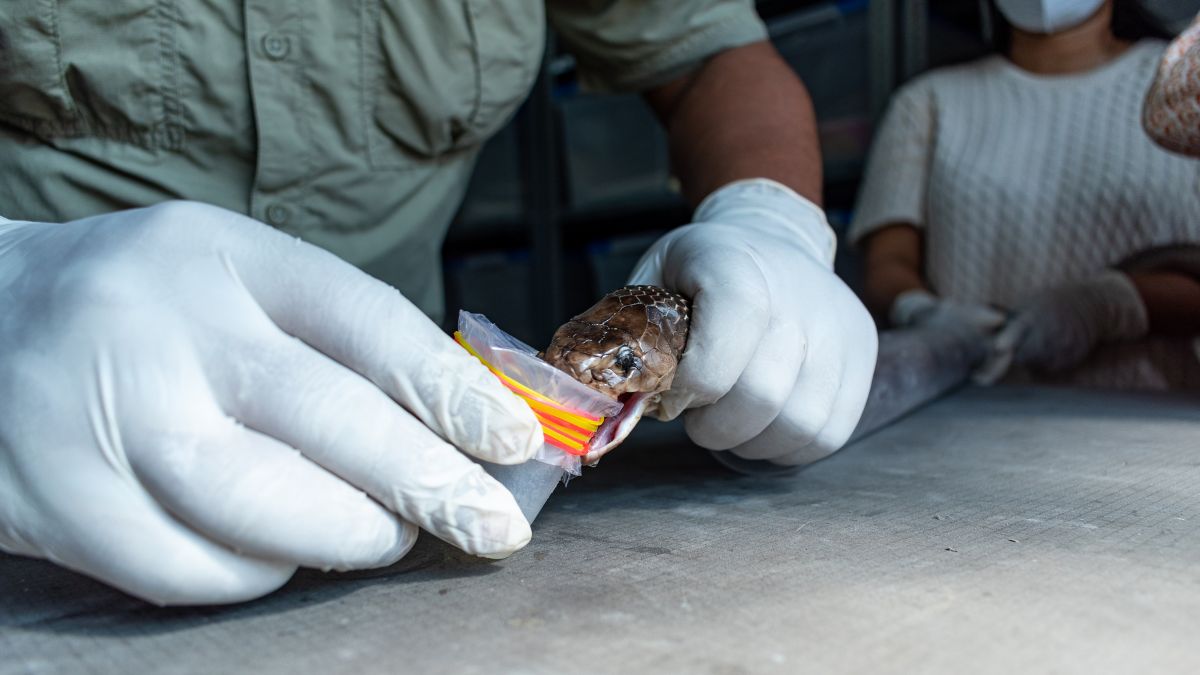
The institute recently conducted an e-auction of lyophilized (powdered) snake venom for four major venomous snake species found in Gujarat-Indian Cobra, Common Krait, Russell’s Viper and Saw-scaled Viper. These four species are responsible for most snakebite deaths in Gujarat.
Officials said the institute received higher-than-expected prices for the venom due to its high quality.
“We had set a base price of Rs 40,000 per gram for Indian Cobra venom but received Rs 44,000 per gram. For Saw-scaled Viper venom, the base price was Rs 50,000 per gram and we received Rs 56,500 per gram. Similar strong prices were received for the other species as well,” an official said.
After the auction, Venom will be supplied to licensed Antivenom Manufacturer.
SRI follows WHO guidelines and houses over 460 venomous snakes
The institute houses around 460 venomous snakes found in different parts of Gujarat. It follows World Health Organization (WHO) guidelines for snake handling and venom extraction. The venom is processed using modern technology and converted into powdered form, which is required for manufacturing antivenom.
SRI works under the aegis of Gujarat Forestry Research Foundation (GFRF), Gandhinagar. GFRF is an autonomous organisation under the Forest and Environment department, government of Gujarat.
SRI is emerging as a crucial centre for research, training and public awareness to reduce snakebite-related deaths in the state. The institute has established a well-maintained serpentarium.
“One of the key challenges in treating snakebites is that snake venom varies from one region to another. Anti-snake venom prepared using venom from distant regions often proves less effective. To address this problem, Gujarat government has set up this institute and it focuses on collecting venom from venomous snake species found in different parts of Gujarat and preparing region-specific antivenom,’’ said Dr D C Patel, Vice-Chairman, SRI, Dharampur, said.
Dr D C Patel, a general surgeon, runs a hospital in Dharampur town, is engaged in treating snakebite victims with over 98 percent success rate. He has been documenting every snakebite case he has handled in his career spanning 35 years.
“The venom extracted from these snakes housed at SRI is of higher quality as the institute follows the WHO guidelines and once, we receive the antivenom prepared from venom supplied by this institute, we expect to reduce snakebite related deaths in the state,’’ Dr Patel added.
Govt allots 2.25 hectares of land to set up world class infrastructure for SRI
To support future expansion, 2.25 hectares of land have been allotted in Valsad district for a permanent campus. A proposal of Rs 11.68 crore has been submitted to the Gujarat government to develop the institute into a world-class centre.
The SRI becomes the second institute in the country after the Irula Snake Catchers’ Industrial Co-Operative Society Ltd (Tamil Nadu) which extract venom for antivenom manufacturing.
Doctors say venomous snakebites can cause paralysis affecting breathing, severe bleeding, kidney failure, tissue damage and even limb amputation. However, most deaths can be prevented if safe and effective antivenom is available on time.
The Gujarat government, under the leadership of Chief Minister Shri Bhupendra Patel, is committed to strengthening snakebite treatment across the state by ensuring the availability of the latest and most effective antivenom in hospitals, with the aim of significantly reducing snakebite-related deaths.
First in the world, India has national plan for snake bite envenoming
India is the first country to have a national action plan for snake bite envenoming. The union government under the leadership of Prime Minister Shri Narendra Modi, launched The National Action Plan for Prevention and Control of Snakebite Envenoming (NAP-SE) in March, 2024. It is a comprehensive framework designed to guide states and Union Territories (UTs) in developing their own action plans, with the primary goal of reducing snakebite deaths and disabilities by 50% by 2030.
Officials say that the initiative aligns with the World Health Organization’s (WHO) global strategy to manage snakebite envenoming as a high-priority neglected tropical disease. Gujarat’s Snake Research Institute (SRI) is a major step towards achieving this goal.
SRI Trains doctors for snakebite treatment in rural areas
Beyond research, Snake Research Institute plays a major role in capacity building. So far, nearly 300 local snake rescuers and over 1,495 doctors and medical officers across 23 districts have been trained in snakebite management. These efforts are helping improve emergency response and treatment outcomes, particularly in rural areas. The institute conducts education programmes, trains educators, and works with local panchayats to dispel myths about snakes and promote safe practices. It has also published a photographic field guide titled ‘Snakes of Valsad’ and produced a documentary to highlight its work.