




Modi Will Be PM in 2029, Says Amit Shah, Targets Rahul Gandhi in Ahmedabad
Ahmedabad | Gujarat — Union Home Minister Amit Shah launched a scathing attack on the opposition Congress, particularly Congress leader Rahul Gandhi by saying “ Narendra Modi will become the...

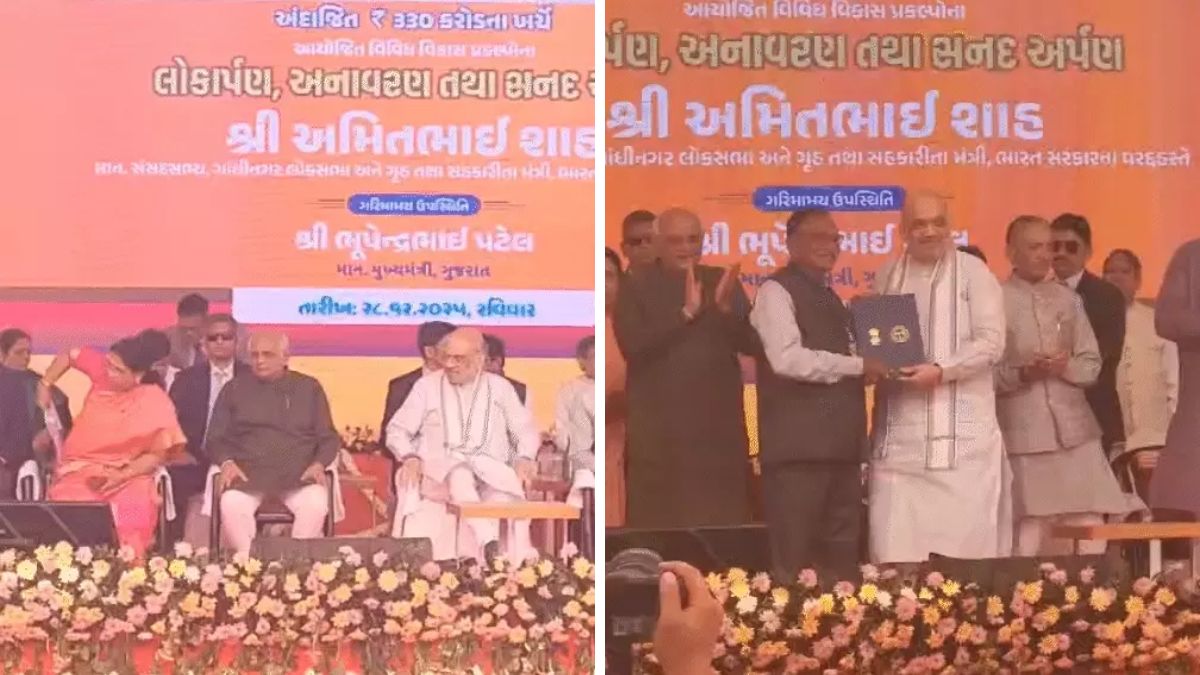
Ahmedabad | Gujarat — Union Home Minister Amit Shah launched a scathing attack on the opposition Congress, particularly Congress leader Rahul Gandhi by saying “ Narendra Modi will become the Prime Minister of the country in 2029, Rahul Baba, don’t get tired of defeat’. Shah was speaking at a public meeting organised in Ahmedabad during the inauguration of a 27-km long drainage line in the western area of Ahmedabad, which was constructed without digging a trench with the use of modern technology.
Attacking the opposition, Shah said, “We have decided to defeat them in Bengal and Tamil Nadu as well. Modi’s government will be formed once again. If we build Ram temple, you oppose it. If you oppose any rule we bring, then from where will you get votes? How will we be able to explain to those who have not been able to convince their own party?
“If we build a Ram temple, you oppose it, if we carry out a surgical strike on Pakistan, you oppose it, if we carry out an air strike, if we expel Bangladeshi infiltrators, you oppose it, if we build a temple in Kashi, you oppose it, if we remove Article 370 or triple talaq, you oppose it, if we bring a Common Civil Code, you oppose it. You oppose what the public likes, where will you get votes, brother. I don’t even have the ability to convince Rahul Baba. If his own party cannot convince him, how can the opposition explain him?”
Union Home Minister Amit Shah said the day marked a joyful and historic moment. He described the event in Vanjar as small in scale but significant in impact. People who had lost everything in 1973 had settled in the area and lived there for nearly 50 years, but for various reasons, ownership rights to their plots had remained unresolved. Shah said it was important to acknowledge the efforts of Amit Thackeray, who worked tirelessly to ensure the completion of all related files. “Today is a landmark day in their lives,” Shah said, adding that from now on, the entire process has been legally formalised for the affected families.
Shah also highlighted the long-standing sewage disposal crisis affecting nearly 15 lakh people and 4,500 housing societies across nine wards of Ahmedabad. The area, he said, had gradually transformed from a cluster of villages into a city, creating infrastructure challenges that required both time and significant financial investment. In several locations, sewage overflow had become a serious health concern. To address this, a comprehensive sewage disposal system costing ₹400 crore has been implemented, with larger-diameter pipelines laid to ensure proper flow. “Sewage water was affecting people’s health, as it was flowing where rainwater should have gone,” he noted.
A sewage disposal system has now been established for a population of 15 lakh. Shah admitted he himself had not believed that the Western Trunk Line could be inaugurated in such a short time. “A major civic problem of a city-sized population has finally been resolved,” he said, adding that he often had to press officials firmly to ensure timely completion, though they consistently assured him the work was nearing completion.
Taking a political dig, Shah referred to Congress leader Rahul Gandhi’s remarks in Parliament questioning why his party continues to lose elections. “If Rahul Gandhi understands these two initiatives, he will understand why,” Shah said. He emphasised that these issues were resolved without protests or large movements, purely out of sensitivity to public needs. “Whether or not people demanded it, the BJP and Prime Minister Narendra Modi ensured the work was done,” he said. Shah added that despite the absence of a sewage system for 15 lakh people for decades, no major agitation ever took place, and urged Gandhi to focus on such governance issues instead of matters beyond his remit.