






How Far We Have Come in Tsunami Preparedness — And What Still Needs To Be Done
World Tsunami Awareness Day (WTAD) is observed every year to remind the world that even though tsunamis are rare, their impacts can be devastating. The day was established after the 2004 Indian Ocean...

World Tsunami Awareness Day (WTAD) is observed every year to remind the world that even though tsunamis are rare, their impacts can be devastating. The day was established after the 2004 Indian Ocean tsunami, one of the deadliest disasters in modern history, which revealed how unprepared many countries were for a hazard of this scale. WTAD encourages countries to strengthen early warning systems, improve preparedness, and promote community awareness so that when a tsunami strikes, people know how to respond quickly and safely.
The day reinforces a simple idea: the more prepared a community is, the more lives and livelihoods it can protect. As in the case of the Indian Ocean Tsunami, where the islands were 1100 kms from the mainland, the time for resources to reach affected areas was considerably longer, making preparedness at the local level all the more crucial.
This year’s campaign, centred on the theme “Be Tsunami Ready: Invest in Tsunami Preparedness,” builds on this understanding. The global community has made significant progress over the past two decades. Early warning systems now cover wider regions, modelling tools and detection technologies have improved, and more governments are integrating tsunami risk into disaster management plans.
Programmes such as the Intergovernmental Oceanographic Commission (IOC) of UNESCO’s Tsunami Ready framework have helped coastal communities adopt practical steps like evacuation planning, public information boards, and regular drills. International cooperation has also strengthened, allowing neighbouring countries to share data and alerts more efficiently. These efforts have contributed to faster warnings, clearer communication, and stronger preparedness planning across regions.
Yet, despite this progress, important gaps remain. Warning messages do not always reach the last mile, community memory fades over time, and many high-risk coastlines still lack regular drills, evacuation route signage, or trained local responders. Financing remains uneven, especially for small coastal towns that struggle to maintain infrastructure or invest in updated technologies. In some places, communities living closest to the water remain the least informed about how to react during an emergency.
The WTAD 2025 campaign calls attention to these challenges and stresses the need for sustained investment in preparedness, better coordination across borders, and continuous public education. The goal is to ensure that tsunami awareness is not a one-time effort but an ongoing practice embedded in community life.
Community-led action has proved to be one of the strongest ways to build long-term preparedness, and India offers several examples of how this approach can make a real difference on the ground. For instance, soon after the 2004 tsunami, Sustainable Environment and Ecological Development Society (SEEDS), a humanitarian organisation that has been working on disaster recovery and resilience for 31 years, began extensive rehabilitation efforts in the Andaman and Nicobar Islands.
The organisation supported displaced families by constructing intermediate shelters for hundreds of households in Little Andaman and by rebuilding Mahila Mandals that had served as important community spaces. These centres gradually evolved into platforms for livelihood training, disaster preparedness exercises, and safe community gatherings. Many of them are now led by local women who have become powerful advocates for disaster resilience, often guiding their neighbours on safe construction, evacuation practices, and community support systems during emergencies.
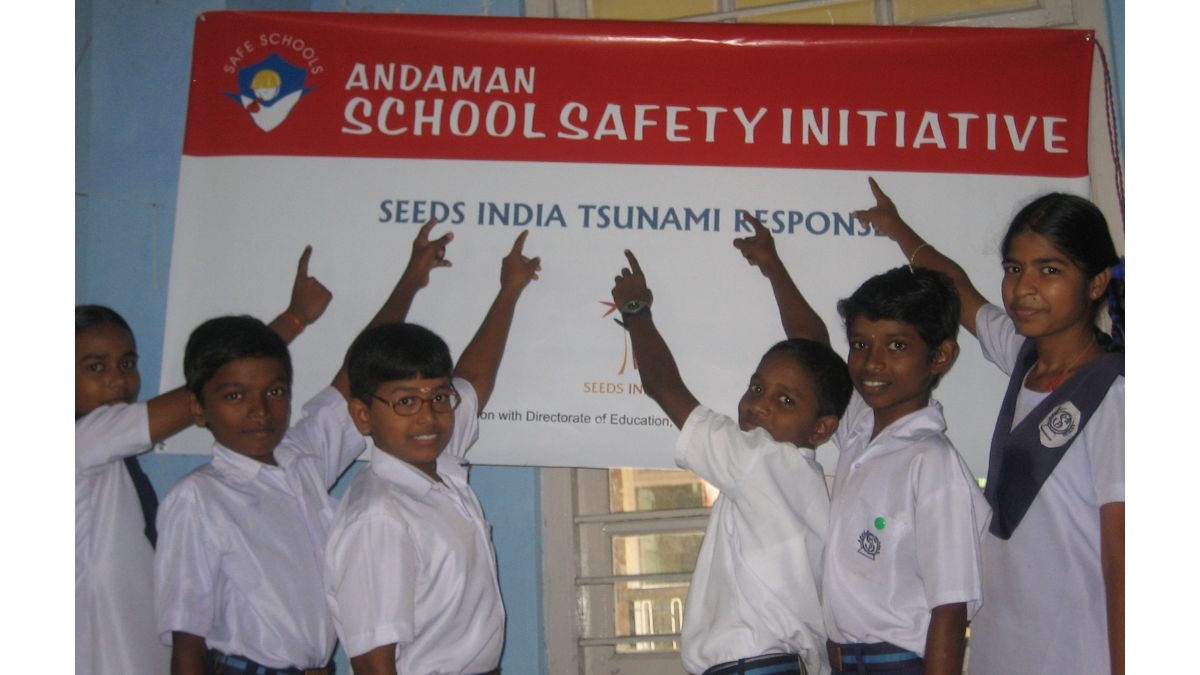
Building on this foundation, the non-profit also recognised the need to prepare the next generation and worked with schools across the islands through the Andaman School Safety Initiative. The programme engaged students, teachers, and government officials to integrate disaster safety into everyday learning. Drills, classroom modules, and awareness sessions helped young people understand risks and the actions they should take during a tsunami or another hazard. School safety is critical because children are often the most at risk during emergencies, yet they are also the quickest to adopt and share life-saving practices. When they learn what to do, they carry that knowledge home, influencing safer behaviour across their families and communities.
Given that the Andaman Islands attract visitors from across the world, preparedness here takes on an added dimension. Awareness and safety planning must include not only local residents but also tourists who may be unfamiliar with the geography or risks. This makes coordination between local communities, authorities, and the tourism sector essential to ensure that evacuation routes, public information, and safety drills are inclusive and accessible to everyone on the islands.
At the same time, there remains scope to deepen the use of technology in preparedness – from digital early warning systems and mobile alerts to real-time risk mapping and data sharing. For island territories separated by vast distances, such tools can make a crucial difference in reaching remote settlements and ensuring no community is left behind during an emergency.
SEEDS’ work extended beyond the islands into mainland India as coastal communities sought ways to rebuild stronger and safer. In Tamil Nadu’s Pulicat region, they helped establish coastal bioshields after the 2004 tsunami. These thick belts of native trees were designed to act as natural buffers against strong waves, storm surges, and gradual sea-level rise. What makes this effort particularly significant is the long-term commitment shown by the local residents. Fifteen years on, the communities continue to care for and expand these bioshields on their own. The result is a living defence system that not only protects the coastline but also supports the local economy by improving soil health and supporting biodiversity. It stands as an example of how environmental restoration and community stewardship can strengthen physical safety and long-term resilience.
In recent years, India has also begun to explore new ways of financing resilience and ensuring faster recovery after coastal hazards. Innovative approaches that link scientific triggers with immediate support are becoming more relevant as climate risks intensify. These efforts reflect a shift towards anticipating losses rather than reacting to them, and they complement ongoing community preparedness measures by providing families with timely assistance after extreme weather impacts. When paired with strong local readiness, such approaches reduce long-term disruption and help protect development gains in vulnerable coastal regions.
As WTAD 2025 urges the world to invest in preparedness, India’s experience shows the value of combining technology, community leadership, education, and nature-based solutions. The progress made globally is encouraging, but the work is far from complete. For coastal communities, preparedness must remain a continuous effort that adapts to changing risks. It requires strong partnerships between governments, scientific institutions, local organisations, and the people who live along the shoreline.